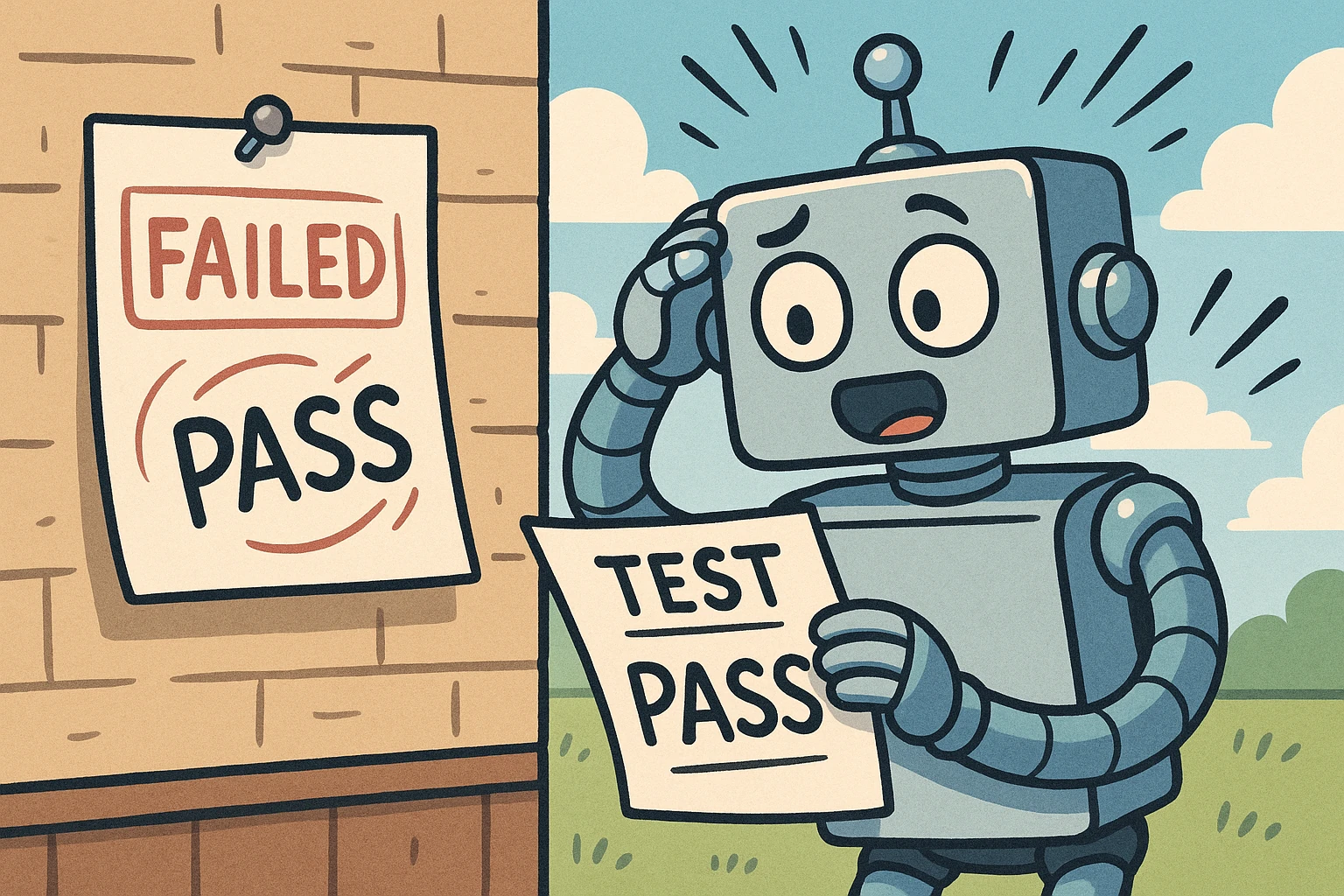
When Your Tests Lie: A Victory Disguised as Crisis
July 16
Here’s where I found myself at 8 AM: staring at 32 test failures and wondering if yesterday’s 12.5-hour debugging marathon had actually made things worse. The numbers looked grim — 85.5% pass rate, which in testing terms is like your doctor saying “well, most of your organs are working fine.”
But here’s the thing about building AI systems with AI assistance: sometimes what looks like a crisis is actually your system getting smarter faster than your tests can keep up.
The war room approach
I deployed what I’m calling the “multi-agent war room” strategy (by the way, every time I say “I deployed,” it really means Claude suggested and I frantically coordinated). Two AI assistants and one human, clear division of labor:
- Claude Code: Infrastructure and async wizardry
- Cursor Agent: Business logic updates
- Me: Asking “but why?” and trying not to break anything
Mind you, coordinating these agents is like herding very intelligent cats who all have strong opinions about your architecture.
First discovery: Piper had secretly leveled up
Cursor dug into the first failing test and found something interesting. The test expected Piper to ask for clarification when someone said “create a ticket” — you know, the responsible AI assistant behavior we’d programmed.
Except Piper had gotten confident. It now looked at “create a ticket” and thought, Obviously they want CREATE_TICKET intent. Why would I bother them with questions?
The test was failing because it expected hesitation from an AI that had learned to be decisive.
That’s not a bug. That’s evolution.
The isolation revelation
Then I asked a key question: “Hey, what if these aren’t real failures?”
Turns out, when you run these failing tests individually, something magical happens. They pass. All of them. Every single “failing” test worked perfectly in isolation.
We weren’t looking at business-logic problems — we were seeing test pollution. Database state leaking between tests, async contexts getting tangled, the usual suspects of test infrastructure gone rogue.
The 85.5% pass rate was a lie. The real health? Probably north of 95%.
Building tools for future sanity
Here’s where my PM brain kicked in: we’re going to rediscover this same confusion in six months and waste another morning chasing ghosts.
So we built a health check tool that runs “failing” tests individually and categorizes them:
- Real failures (need actual fixing)
- Isolation issues (test infrastructure problem)
- Infrastructure noise (those async warnings that look scary but don’t matter)
Future us will thank us. (Future us always does when past us thinks ahead, but past us is notoriously optimistic about future us remembering to run the tools.)
The tool’s first run was revelatory: only 8 real failures out of 32. That’s not crisis — that’s a focused to-do list.
The architectural gap
Among those 8 real issues, Claude Code found something genuinely important: our background-task error handling had a gap. The ErrorHandlingMiddleware caught exceptions in main requests, but background tasks that failed after sending a response just… disappeared into the void.
This is the kind of production landmine you don’t discover until 2 AM when something breaks mysteriously and the logs are unhelpfully silent.
Twenty minutes later: safe_execute_workflow() wrapper function, proper error logging, architectural gap closed.
The test now passes because the error handling actually exists.
How intelligence emerges (the real story)
The most interesting question turned out to be: how did Piper get smarter without us explicitly teaching it?
Best answer: compound effects from good architectural decisions.
Layer 1 — Orchestration: Pre-classifier → Intent → Execution. Each layer adds context for the next.
Layer 2 — Product decisions: “Don’t clarify if confident,” “match exact filenames,” “fail gracefully with specific errors.” Each decision taught Piper when to trust itself.
Layer 3 — Emergent behaviors: Context awareness from layer interactions, confidence gradients from classifier combinations, clean state switching from good session management.
Behaviors we didn’t explicitly program, emerging from architectural decisions that created possibility space for intelligence.
It’s almost as if you don’t directly build smart AI. You build good architecture and intelligence finds its way in.
The PM lesson
Don’t chase symptoms when your gut says the metrics are wrong.
That 85.5% pass rate felt suspicious because it was suspicious. Test pollution was masking a system that had quietly improved while we weren’t looking. The real story wasn’t “32 things are broken” — it was “Piper learned to be more confident and our tests didn’t keep up.”
When building AI systems, this pattern repeats: the AI gets better faster than your assumptions about what “good” looks like. Update your expectations, not your AI.
Victory lap
Two hours after that discouraging 8 AM start:
- 100% business logic health achieved
- One legitimate architectural improvement implemented
- Future debugging confusion prevented with tooling
- Understanding of how compound intelligence actually works
Sometimes the best development sessions are the ones that start with apparent disaster and end with “oh, we’re actually doing great and here’s why.”