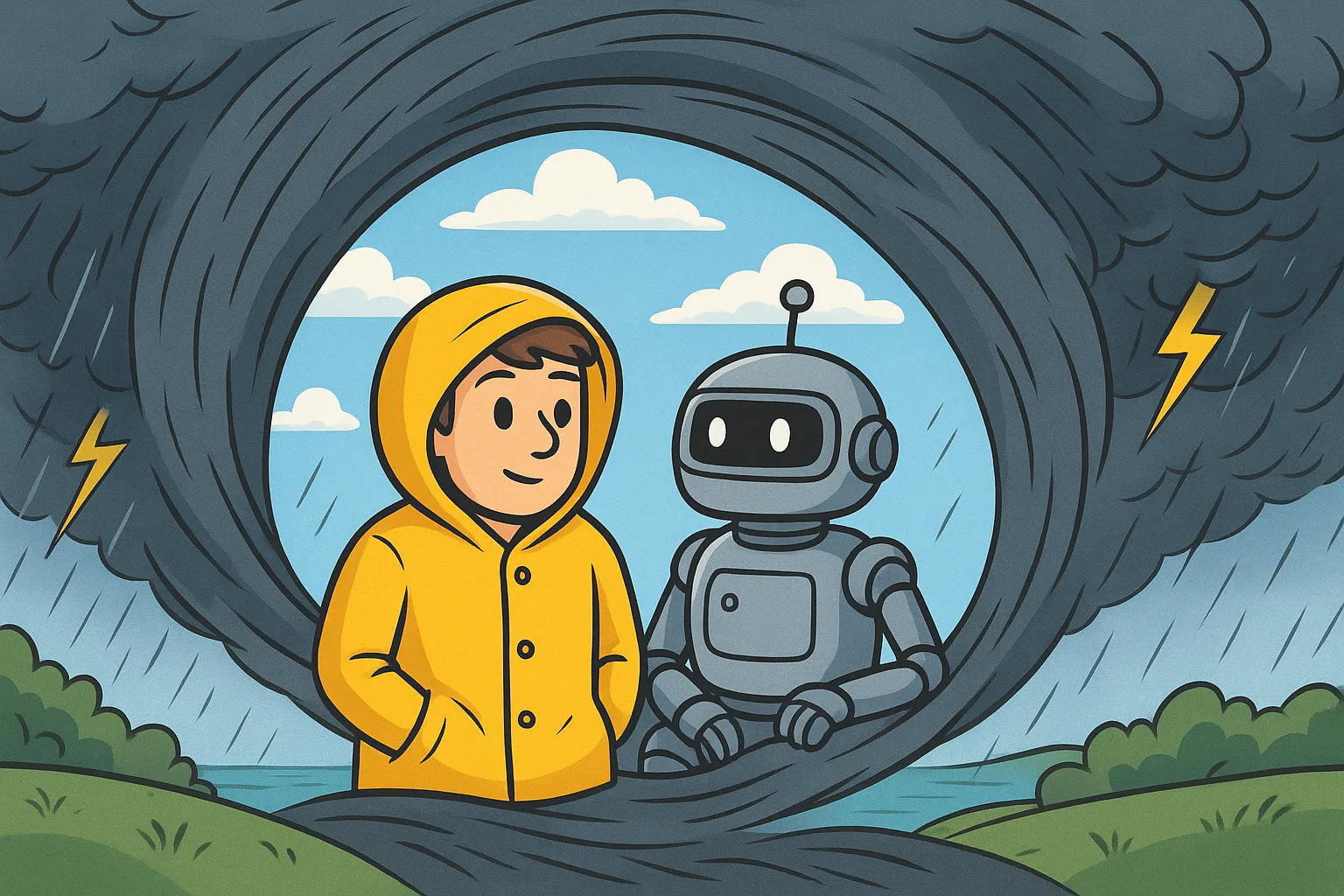
When Your Methodology Holds Under Pressure
September 15
Monday morning brought the kind of convergence that usually sends me into crisis mode: a UI regression blocking all testing, documentation work piling up, strategic planning deadlines looming. The old me would have dropped everything to fight the fire, probably staying up too late trying to debug the “infinite thinking” problem while everything else fell behind.
Instead, I deployed the methodology.
Not because I’m disciplined or particularly organized, but because over the past few months I’ve learned that systematic approaches handle complexity better than individual heroics. Even when — especially when — there’s pressure to just “fix it quick.”
Multi-agent coordination under fire
The UI bug looked straightforward: something about config nesting causing the standup interface to hang on “Thinking…” The gameplan was clear — backend config fix, architectural cleanup, done in 90 minutes.
I deployed both Code and Cursor agents with distinct roles: Code for backend investigation and fixes, Cursor for UI validation and cross-checking. Not because I’m fancy, but because I’ve learned that different agents have different strengths, and complex problems benefit from multiple perspectives working in parallel.
Ten minutes in, Code reports back: “The config nesting issue doesn’t exist. The /api/github/activity endpoint you're looking for isn't in the current web application."
In the old days, this would have been frustrating. Wrong diagnosis, time wasted, back to square one. But the methodology has taught me that investigation revealing different problems than expected isn’t failure — it’s the system working.
Following the evidence where it leads
Code’s static analysis was thorough but limited. Cursor’s runtime testing told a different story: the web server was running fine, but the backend API was throwing a TypeError during initialization. Not a config issue — an architecture gap.
The real problem was a parameter mismatch in the standup orchestration service. A constructor expecting github_domain_service but receiving github_agent. Three layers deep from the original diagnosis, but discovered systematically rather than through frantic debugging.
What struck me wasn’t that the original diagnosis was wrong — that’s normal. It’s part of the process. It was how the methodology kept both agents coordinated and productive even as the problem shifted. Code fixing backend initialization while Cursor validated the UI response. Cross-validation at logical checkpoints rather than the end.
No heroics. No all-nighters. Just systematic execution that adapted to what we actually found rather than what we expected to find.
The recursive loop
The meta-story made me smile. While the agents were debugging systematically in parallel, I was simultaneously restoring methodology templates that had been accidentally compressed from 750 lines with 15 STOP conditions down to basic 84-line outlines. (Sometimes LLMs get a bit too excited about Marie Kondo-fying stuff.
So I was fixing the methodology documentation while the methodology was proving its worth in real time. Using the system to repair the system while the system demonstrated why it matters.
Insert ourobouros image here.
The template restoration revealed how much enforcement detail had been lost — evidence requirements, cross-validation protocols, progressive tracking mechanisms. All the scaffolding that makes complex work sustainable rather than exhausting.
By the end of the day: UI bug resolved through three-layer investigation, documentation architecture completely overhauled, strategic roadmap updated with clear sequencing rationale. Not because we worked harder, but because we worked systematically.
Sustainable momentum under pressure
The satisfaction can notfrom solving hard problems — though we did that. It was the way this methodology handled complexity without burning me out or sending my assistants down rabbitholes. The agents coordinated smoothly. The investigation revealed system architecture nobody fully understood before. The strategic planning built naturally on tactical discoveries.
This is what working with AI can look like when you have systematic approaches rather than ad-hoc prompting. When you trust the process enough to deploy it under pressure rather than reverting to crisis mode.
I think it’s the same with all-human teams too?
The old me would have spent Monday in crisis mode, fixing the immediate problem while everything else accumulated. The current me spent Monday making systematic progress across multiple fronts simultaneously. Same hours, fundamentally different experience.
Methodology working under pressure isn’t dramatic. It’s the opposite of dramatic — it’s reliable progress when things get complex, sustainable execution when there’s multiple priorities, cognitive load distribution when your attention wants to fragment.
Sometimes the most impressive thing about a system is that it works quietly when you need it most.