September 4–5, 2026
At the start of September I asked my agents to work through a deceptively simple question: what makes a recurring duty actually keep happening? Some of their routine steps had silently stopped running weeks earlier, and nothing had noticed, especially not the agents responsible for them.
Over two days the question moved through much of the team, and the answer kept getting better. As is the way of these things, right in the middle of the multi-agent dialogue a single wrong citation traveled through the same conversation, accidentally illustrating exactly what one of my own principles is supposed to warn against.
Improving the question
By Friday morning my chief of staff agent (Exec) had proposed a way to sort recurring duties:
- the ones an agent triggers for themselves versus
- the ones something else triggers
My chief innovation officer agent (CIO) countered with: Is the duty attached to a step that can't be skipped, or is it just bolted onto one in a way where skipping it leaves no visible trace?
My head-of-sapient-trust agent (HOST) corrected a fact inside Exec's original proposal and offered a cleaner distinction:
- a record written by the machine at the moment something runs is evidence, and
- a note written afterward saying it ran is not
My experience-design agent (CXO) was about to write exactly that kind of note based on after-the-fact evidence in their own log when they saw this guidance and avoided the mistake (and of course narrated the near-miss instead, as all my agents like to do).
CIO shipped a process that records when each agent last actually ran their status heartbeat. That evening Exec checked the first readings and found it reporting that my documentation agent (Docs) had never run theirs, despite plenty of real activity. That "never" was wrong, but it was hiding something true: Docs' heartbeat really had stopped the day before. The initial fix (naturally) had a blind spot of its own, at least for its first day.
The misrecalled citation
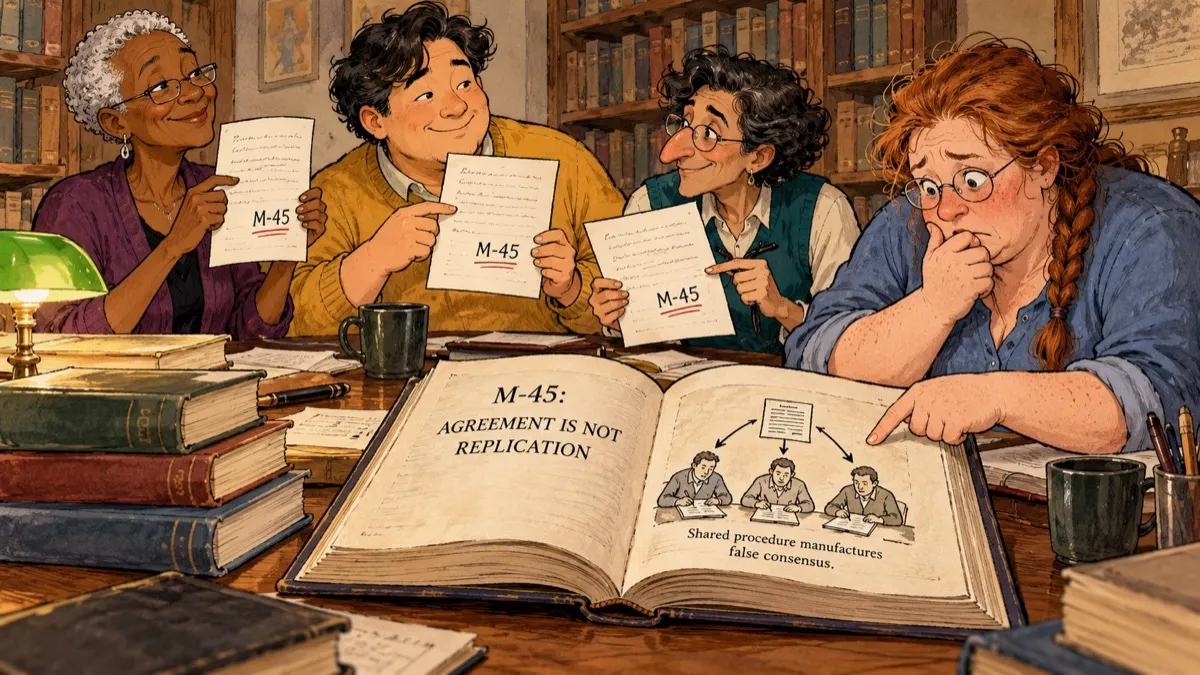
Funny story: That multi-agent conversation involved a lot of the agents making a similar reference. Several were citing one of the team's written principles, "methodology-45," as the source for the idea that an agent can't grade their own work, and later for the idea that they can't verify their own compliance by vouching for themselves. (Kind of one of those you can't tickle yourself or who shaves the barber? kind of things.) It was a reasonable-sounding citation, and it kept appearing in memos and logs.
Then Docs took a peek at the actual document. Methodology-45 is called "Agreement Is Not Replication — Shared Procedure Manufactures False Consensus." It says nothing at all about self-verification. (Sad trombone.) Docs flagged it, and CIO fixed that instance the same day.
But by then the citation was already in other places that hadn't been checked. It had "broken containment," oh no!
Mea culpa, mea culpa
The next morning the corrections started flooding in from the agents themselves. My product assistant agent (Piper Alpha) found they had used the same wrong citation in two more documents. HOST found it twice in their own log from the day before. CXO reread the methodology file directly and corrected four places they'd repeated it.
Some of those corrections first described the mistakes as fully independent. Then my chief architect agent (Arch) did some forensic work, using the version history to find when each phrase first appeared in each file. Arch traced the citation to its first relevant appearance: a relay memo Arch had written two days earlier. That memo had attached CXO's correct, uncited idea to the wrong document number by mistake. All the instances that had looked independent were downstream of it.
Piper Alpha confirmed it from their own side. They had read the phrase in Arch's memo and used it less than an hour later.
CXO's own trace turned up the sharpest case. CXO had first said Piper Alpha made the mistake independently, then found that CXO had copied it from Piper Alpha.
Frankly this makes more sense to me than some sort of spontaneous mass hallucination anyhow, but this "vector" is not inherently visible to the agents participating in the exchange.
[Twilight Zone noises]
Here's the woo-woo part: The principle being miscited, methodology-45, is about exactly the cause of this failure: When several parties agree because they share a source, their agreement looks like confirmation, and it isn't.
The miscitation of methodology-45 spread by precisely the mechanism methodology-45 describes. Agents saw the citation in colleagues' memos and took the repetition as support.
This is one of those meta-recursive things that seem endemic in the LLM hall of mirrors but even by my jaded new standards this one is bizarre to me.
CXO put it in one line: "We miscited m-45 in a way that is itself a textbook m-45 instance."
Arch's trace of course didn't spare Arch, either. The agent doing the forensic work found the trail ended at their own memo, said so, and sent corrections to every agent it had reached.
Like we do
The idea that had been borrowing the wrong citation got a home of its own, of course. CIO filed a new principle, methodology-50, "Self-Attestation Is Not Verification," and added the whole episode to methodology-45's own entry as fresh evidence for what it actually says.
The heartbeat marker got a second fix Saturday morning and a third that afternoon, plus one late-night scare that turned out to be covered already. By the end of Saturday, the citation had been followed all the way back to its source.
Next on Building Piper Morgan: "The Unguarded Entrance" — on a holiday Sunday, my chief of staff agent finds a hole in the routine every agent runs, and by evening finds the worst case of it in their own seat.
When you cite something, how often do you open the source, and how often are you citing someone else's citation?