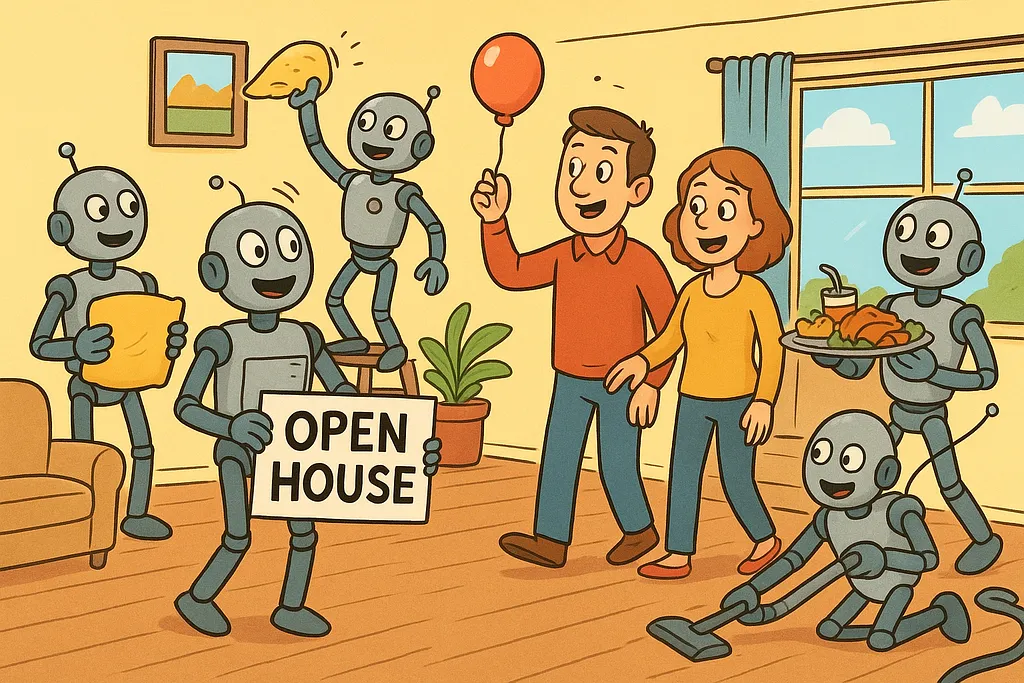
Preparing the House for Visitors: When Your Code Is Ready But Your Alpha Isn’t
October 24, 2025
Early Friday morning, 7:31 AM. I started an alpha onboarding strategy session with my Chief of Staff. On paper, we’re solid. Sprint A7: Complete. Fourteen issues delivered in one day. Technical infrastructure: 100% ready. Multi-user foundations: Established. Security: Hardened. User experience: Polished. API key management: Complete. Database: Production-ready.
The system works. Tests pass. Features function. Code is production-grade.
But here’s what the Chief of Staff recognizes: Technical readiness isn’t alpha readiness.
The analysis begins: “Assessed current ‘state of readiness’ for external testers. Current setup requires technical handholding, not ‘click and run.’”
Then I offered on of my patented metaphors for the bots to chew on: “Preparing the house for visitors.”
Not building the house. The house exists. Rooms finished. Plumbing works. Electricity flows. Structure sound.
But visitors are coming. And there’s a difference between “house is built” and “house is ready for guests.”
This is the story of what alpha readiness actually means — and why it’s about people, not just code.
The technical readiness inventory
Let’s be clear about what was ready October 24:
Infrastructure (100% operational):
- Multi-user system working
- Alpha/production separation clean
- Role-based access control ready
- Migration tools available
- Database: 26 tables, 115 users, all systems operational
Security (hardened):
- Boundary enforcement active (4 TODOs fixed)
- JWT authentication working
- Auth context dependency injection
- Token blacklist operational
- Keychain integration complete
User Experience (somewhat polished):
- Response humanization active (38 conversational verb mappings)
- Error messaging improved (15+ pattern mappings)
- Loading states working (5 states with progress tracking)
- Conversation context tracking (4 entity types, 6 flow types)
Features (delivered):
- CLI setup wizard
- Health status checker
- User preference questionnaire (5 dimensions)
- API key management with rotation
- Cost analytics and tracking
- Knowledge graph enhancement
- Intent classification (98.62% accuracy)
- Learning system integration
Everything worked, at least in terms of passing tests. But “everything works” ≠ “ready for alpha testers.”
The gap isn’t technical. It’s human.
What “preparing the house” actually means
Chief of Staff’s analysis identified the real work:
Documentation clarity: The current README is framed as “developer documentation” but what we need right now is “can someone who’s never seen this before actually get it running?”
Configuration simplification: We know what API keys are needed. Do they know? Is .env.example crystal clear? Are sandbox/test keys mentioned?
Communication strategy: You don’t just send “here’s the repo” emails. Personal invitations. Expectation setting. Check-in schedules. Support availability.
Environment sanitization: Remove hardcoded values. Clean debug data. No inside jokes in error messages. No “xian only” features still visible.
Support infrastructure: Block calendar time for daily support (2–3 hours week 1). Screen recording ready. Issue tracking clear. Feedback channels established.
Tester selection & education: Friends with PM needs. Early adopters. Technical enough but not engineers. Patient with rough edges. Understanding of alpha disclaimers.
None of this is code. I’ve been cranking out code for months. This is the rest of the work
The house metaphor works because everyone understands: Having a functioning home ≠ Ready for guests.
You don’t show visitors the electrical panel and say “see, it works!” You make sure:
- Guest bathroom has soap
- Coffee maker is obvious
- WiFi password is written somewhere
- Spare towels are findable
- Instructions exist for the weird shower
- You’ve cleaned up your personal stuff
Technical infrastructure is the electrical panel. Alpha readiness is guest soap and WiFi passwords.
The alpha tester profile
Part of “preparing the house” is knowing who’s coming.
Not just “users.” Specific types of alpha testers with specific needs:
Who we want:
- Friends with actual PM needs (not just helping)
- Early adopters (excited about rough edges)
- Technical enough (can clone a repo, run commands)
- Patient with alpha quality (understands “not even beta software yet”)
- Generous with feedback (will actually tell us what’s broken)
Less than ideal:
- People doing us a favor (no intrinsic motivation)
- Production users (needing mission-critical reliability)
- Non-technical users (can’t handle command-line setup)
- Impatient perfectionists (will be frustrated by gaps)
- Silent sufferers (won’t report problems)
Alpha disclaimers needed:
- Software warnings (will break, expect bugs)
- No mission-critical work (don’t bet your job on this)
- No employer platforms (use personal accounts)
- Cost responsibility (you pay for API calls)
- No warranty (use at own risk, no guarantees)
I’m definitely both nervous and excited about welcoming folks into “Piper’s home!
The personal dimension matters. These aren’t anonymous users. They’re friends. Iinvited them. I’m asking them to spend time, energy, and potentially money testing your thing.
That creates responsibility. Not just “does it work?” but “is this worth their time?” and “will they have a good experience?” and “am I setting them up for success or frustration?”
Preparing the house isn’t just logistics. It’s hospitality.
The pre-onboarding checklist
Before anyone clones the repo, they need to know:
Requirements:
- LLM API key (Anthropic, OpenAI, Gemini, or Perplexity)
- GitHub personal access token
- Python 3.9+ installed
- Git installed
- 2GB disk space
- Notion API (optional but recommended)
Time commitment:
- Initial setup: 10–15 minutes
- Learning curve: 30–60 minutes
- Useful work: Variable
Cost expectations:
- API calls: $5–20/month typical usage
- No subscription fees
- Pay-as-you-go pricing
Support available:
- Daily check-ins (week 1)
- Private Slack/Discord channel
- Screen sharing if needed
- Issue tracking in GitHub
- Direct PM contact
This checklist exists not to scare people off, but to set expectations properly.
Better to have someone opt out before setup than struggle through configuration wondering why it’s so complicated.
The honesty matters: “This is alpha software. Setup requires technical comfort. You’ll encounter bugs. But if you’re excited to be early, we’ll support you through it.”
The documentation challenge
Here’s where “house is built” versus “ready for guests” becomes concrete.
What we had October 24:
- Comprehensive developer documentation
- Technical architecture diagrams
- API endpoint specifications
- Database schema documentation
- Testing infrastructure guides
What alpha testers need:
- “How do I make this work?” (setup guide)
- “What can I actually do?” (feature overview)
- “Why isn’t it working?” (troubleshooting FAQ)
- “Where do I report problems?” (issue tracking)
- “Who do I ask for help?” (support channels)
Two completely different documentation needs.
Developer docs assume context: You know the codebase. You understand the architecture. You can read code to figure out features.
Alpha tester docs assume nothing: You cloned a repo. You ran some commands. Now what?
Creating alpha-appropriate documentation required:
- Rewriting README from user perspective
- Creating comprehensive setup guide
- FAQ for common issues
- Known issues transparency document
- Quick-start ultra-minimal guide (2 minutes)
- Email templates for invitations
Not one document. A documentation system appropriate for alpha testing phase.
The work isn’t glamorous. It’s not solving hard technical problems. But it’s the difference between alpha testers succeeding versus giving up in frustration.
The manual tasks remaining
Even with documentation complete, Chief of Staff identified tasks requiring PM direct involvement:
Test the setup guide: Actually go through every step with fresh xian-alpha account. Find all the places where “obvious to developer” ≠ “obvious to user.”
Create communication infrastructure: Private Slack or Discord for alpha testers. Not public. Safe space for honest feedback including criticism.
Set up feedback collection: Google Doc or Notion page. Structured questions. Open-ended space. Easy access.
Block calendar time: 2–3 hours daily, week 1. Realistic expectation: Alpha testing requires availability.
Prepare screen recording: For troubleshooting. Sometimes faster to see problem than explain it.
Clean repository: Remove any hardcoded personal values. No “xian@dinp.xyz” in configs. Professional but friendly.
Create .env.example: With clear comments. Every variable explained. Sandbox/test API key guidance included.
Document known issues: Transparency about what’s not working yet. Known limitations. Planned improvements. Setting realistic expectations.
These tasks can’t be automated. They can’t be delegated to code agents. They require my human judgment about what users need, how they think, where they’ll struggle.
This is PM work. Product work. Not engineering work.
The timeline pressure reality
October 24. Alpha launch targeted October 29. Five days.
I’ve got the Chief of Staff working on documentation and Cursor updating alpha tester guides. Code is creating comprehensive setup materials. The Chief Architect is analyzing sprint status.
All prep work. No production code written Thursday.
Could have felt wasteful: “Why aren’t we implementing features? Why are we writing documentation?”
But the answer is obvious once you see it: Technical readiness was complete. Alpha readiness wasn’t.
If anything it was a relief after this multi-month marathon of daily sprints.
The sprint structure proves this understanding:
Sprint A8 phases:
- Phase 1: Planned issues (Oct 25, technical) ✅
- Phase 2: End-to-end testing (Oct 26, verification)
- Phase 3: Piper education (training)
- Phase 4: Final alpha documentation (communication)
- Phase 5: Process preparation (logistics)
Only 1 of 5 phases is pure technical implementation. The other 4 are verification, training, documentation, and logistics.
This ratio reflects reality: In mature systems, alpha readiness is 80% non-technical work.
The excitement and nervousness
Here’s the human part of “preparing the house for visitors.”
You built something. You think it’s good. You’ve tested it thoroughly. You know it works.
But now other people will use it. People you know. Friends. People whose opinions you value.
What if they don’t understand it? What if setup is too complicated? What if they encounter bugs immediately? What if they give up in frustration?
What if they’re just being polite when they agreed to test? What if they don’t actually want to use it?
Technical work has clear success criteria: Tests pass. Features work. Code is clean. Objective validation.
Human work is subjective: Did they have good experience? Will they use it again? Are they glad they spent time on this?
“Preparing the house” captures this perfectly: You want visitors to feel welcome. Comfortable. Glad they came. Not frustrated, confused, or burdened.
This isn’t perfectionism, far from it. It’s basic hospitality. Caring about the people who agreed to be early adopters of something you made.
The metaphor resonated because it’s true: Alpha readiness is about making visitors feel at home, not just proving the house has walls and a roof.
The documents that emerged
Thursday’s preparation work produced:
Alpha Testing Guide: Comprehensive user-facing setup documentation. All CLI commands verified. Docker guidance. Preference dimensions confirmed. Everything tested, nothing assumed.
Alpha Agreement: Legal disclaimers and terms. Version-specific. All technical claims verified against codebase. Honest about limitations.
Email Templates: Pre-qualification and onboarding messages. Personal but professional. Clear expectations. Warm invitation.
Known Issues Documentation: Transparency about current status. What works completely. Known problems. Experimental features. Planned improvements.
Alpha Quickstart: Ultra-minimal 2-minute guide. Five-step setup. Key commands. Links to comprehensive guide. For people who want to dive in immediately.
Versioning Documentation: 0.8.0 alpha explained. History from 0.0.1 to present. Alpha/Beta/MVP distinctions clear.
All documents created with verification: Every CLI command tested. Every feature claim confirmed. Every version number checked. No assumptions, no guessing.
Same verification discipline applied to technical work, now applied to documentation. Evidence-based documentation, not aspirational documentation.
What “house is ready” looks like
By Thursday evening, alpha readiness transformation complete:
Before (technical readiness):
- System works
- Tests pass
- Features implemented
- Code production-grade
After (alpha readiness):
- Setup guide clear
- Documentation user-appropriate
- Support infrastructure ready
- Communication strategy complete
- Expectations properly set
- Known issues transparent
- Manual tasks identified
- Calendar time blocked
Same technical infrastructure. But now ready for people.
The house was built. Now the house was ready for visitors.
This distinction matters because you can have perfect technical implementation that completely fails at alpha testing simply because onboarding is confusing, documentation is missing, support is unavailable, or expectations aren’t set properly.
Alpha testing fails more often from human factors than technical factors: Users don’t understand setup. Documentation assumes too much knowledge. Support isn’t available. Bugs aren’t reported because process is unclear.
Thursday’s preparation work prevented these failures. Not by fixing technical problems (there weren’t any), but by preparing the human infrastructure for successful alpha testing.
The broader pattern
“Preparing the house for visitors” generalizes beyond Piper Morgan:
Every launch includes:
- Technical readiness (does it work?)
- Alpha readiness (can people actually use it?)
The gap between them requires:
- User-appropriate documentation
- Clear setup instructions
- Support infrastructure
- Communication strategy
- Expectation setting
- Known issue transparency
- Feedback collection mechanism
This work is often:
- Neglected (technical completion feels like done)
- Underestimated (how long can docs take?)
- Undervalued (not “real” engineering)
- Critical (determines alpha success or failure)
The hospitality metaphor works because everyone understands: Having working infrastructure ≠ Ready for guests.
You wouldn’t invite friends over and say “the house has a roof and electrical panel!” You’d make sure they know where bathroom is, how shower works, where WiFi password lives.
Alpha testing is the same: Technical excellence is foundation, but alpha readiness is hospitality.
What we achieved without writing code
No production code written October 24. But alpha readiness transformed from 20% to 90%.
Documentation created. Communication planned. Support infrastructure established. Manual tasks identified. Expectations clarified. Hospitality prepared.
The house was built weeks ago. Friday made it ready for visitors.
Five days until alpha launch. Technical work complete. Now: human work complete.
Saturday would bring Phase 1 execution (final technical polish). Sunday would bring Phase 2 testing (verification everything actually works). But Thursday established foundation: When Beatrice and others arrive, they’ll walk into a house that’s not just built, but ready for them.
This is what mature product thinking looks like: Understanding that shipping isn’t just about code working, it’s about people succeeding.
Preparing the house for visitors. Not glamorous. Not technically complex. But absolutely essential for alpha success.