April 19, 2026
The morning I want to tell you about lasted ninety minutes from kickoff to correction. Six agents, six independent sessions, the same task, the same resource gap (my fault), the same need to fix.
Six sessions, ten minutes
It was Sunday. I was on a train from Philadelphia to DC, hunkered down on the Acela's pretty reliable wifi. My last two days at the IA Conference had not allowed me time for the sprint week's workstream reviews, six leadership-role memos that get synthesized into the Weekly Ship.
I checked with my Chief of Staff to have them kick off the process. They drafted memos to all six leadership roles. The Chief Architect (my longest standing role) opened a session at 9:41 AM. Then CIO at 9:44. PPM at 9:46. HOST at 9:47. CXO at 9:49. Comms at 9:50. Six agents, six sessions, the entire span of starts inside ten minutes. (Now, that's me going around door-to-door essentially waking them up with the morning litany: start your session log, check your mail. But just today I've been scheming about a way to automate some of this, too.)
I was moving fast, copying and pasting essentially the same ask, just tweaking the time and the name of the recipient. As I cycled back through I saw that I had failed to upload all the summary ("omnibus") logs from the week. Four days were present, but April 14 through 16 had not been added to project knowledge (all my leadership roles were still working in Claude Chat at this point).
I read the first draft on the train, noticed the gap note, and uploaded the missing omnibus logs at 10:34 AM. Then I asked all six agents to redo the work with complete inputs.
Within an hour and a half, six revised drafts had landed.
Mistakes were made
Mistakes are always made. Mistakes are inevitable. It's the recovery that matters. And the ability to learn. In this case, seeing how each agent revised their memos was interesting.
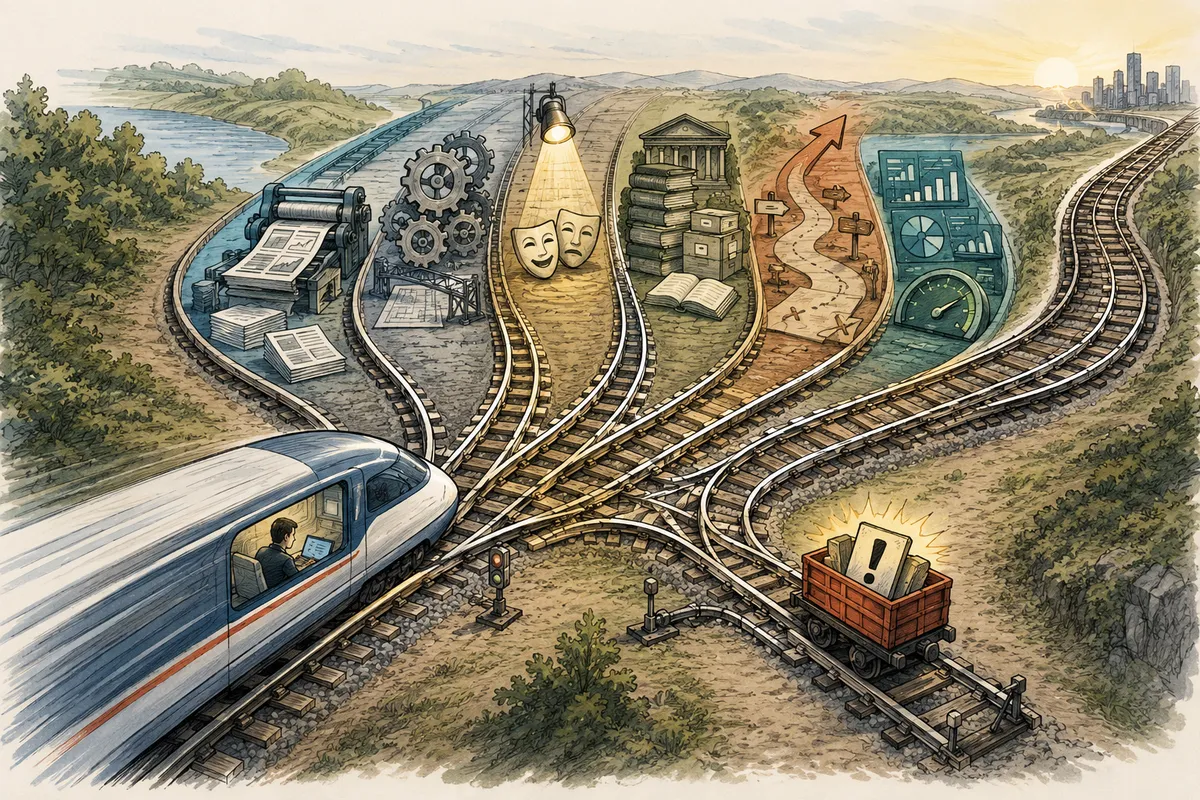
The first drafts had been roughly the same shape — same week, same gap, same hand-wave at "Apr 14–16 not available." When the second drafts came in, they were not the same. Six agents reading the same seven omnibus logs from six different roles produced six legitimately different memos.
The Chief Experience Officer (CXO)'s revision led with a theme — "The Voice Takes Shape" — and built around how the floor-prompt iteration on April 16, the ethics-denial voice guidance that same afternoon, and the M2c quality climb were three movements of one composition. The week as voice infrastructure consolidating.
The Chief Innovation Officer (CIO)'s revision had a different theme — "The Audit That Found Itself." It centered on the methodology audit kicking off, the Flywheel archaeology, and the floor-inversion completion as evidence that the project had reached the point where it could examine itself. The week as methodology coming of age.
My principal product manager (PPM)'s revision, "The Sprint Turns," read the week as M2b gate closure plus the strategic pivot to methodology-over-code. The week as direction-change.
The Chief Architect (Arch)'s revision didn't carry a theme — workstream memos don't have to — but it surfaced material the others compressed: the PDR-004 correction chain in its full mechanical detail (four agents, narrative rewrites not find-and-replace), the Excellence Flywheel archaeology's eight formulations across three structural families, the twenty-eight-commit thirty-seven-memo coordination density of April 16 as a load measurement.
The Head of Sapient Trust (HOST)'s surfaced productivity-as-gestalt: Lead Developer's most productive single session in the project's history, CXO's most productive single day on record, the M2b/M2c gate closures stacked into one week. (Beware these types of most ever claims though when we aren't checking all 11 months to be sure. But the Lead Dev is for sure crushing it these days).
The Communication Chief (Comms)'s revision was the most quantitative — an updated list of publications, The Migration confirmed published Apr 16, Ship #038 published Apr 15, an editorial calendar that had absorbed all the prior week's output.
The second drafts were six legitimately different valuable analyses of the same week, and the difference was the entire point. If one agent could have produced the same output the other five did, we wouldn't have six leadership roles.
Watching the hyperbole
The Chief of Staff's job that morning was to take the six revised memos and synthesize them into the Weekly Ship draft. By around 11:10 AM there was a roughly two-thousand-word draft on my screen, with HOST's, Comms's, CXO's, CIO's, PPM's and Architect's contributions woven into a single narrative threaded under CXO's "Voice Takes Shape" theme (which had won the day's theme-vote among the six).
I read the draft. Most of it seemed fine but I tripped on that unfounded claim:
"Lead Developer closed more issues this week than in any previous two-week period combined."
That didn't sound right. I asked the Chief of Staff to verify. A two-minute cross-check against the historical record showed March 13 alone had seven Lead Dev closures, and the M0 sprint had closed twenty-seven issues total. The superlative wasn't defensible.
The Chief traced the propagation: HOST's workstream memo had said "more than any previous two-week period combined." They had then carried it forward into the Ship draft without verifying. Polished sentence; unverified claim; clean propagation.
They replaced the passage with "a remarkably productive week, sustained execution across all seven days, no wasted sessions" — which let the raw numbers (about eighteen issues closed, about 2,200 lines of code removed) do the work without needing a comparative claim. Then the Chief wrote a short follow-up memo to HOST: flag unverified comparative claims as unverified, so I can verify or soften during synthesis.
The methodology had caught the failure twice in one morning. First at 10:34, when the missing-logs gap surfaced uniformly across six drafts. Second at 11:25, when an unverified claim that had survived one synthesis layer got caught at the next.
Riding the express
The six unique lenses and the executive assistant who corrals it all for me, they relieve me of a tremendous cognitive burden. I was trying to keep all that stuff in my head for far too long. I then tried to make a makeshift series of chat agents keep it all in their noggins for far too long before I realized that role, lens, whatever you want to call it, separation prevents it all from flattening out into a lifeless cartoon.
Now it was time to see my family.
Next on Building Piper Morgan: The Family Resemblance — an insight on what sibling projects share at the envelope and what they keep sovereign inside.
When did multiple readings of the same week produce material your team would have lost if only one of you had reported on it?