Stage 3 Complete
January 2–5, 2026
The first week of the year began with a release and ended with a milestone. In between: organizational expansion I hadn’t planned but clearly needed.
January 2 was straightforward. Version 0.8.3 deployed to production. Adam Laskowitz joined as our third alpha tester. The Communications Director role transitioned to a new chat with expanded capacity. Clean work, clean endings.
A six-agent day
Six agents worked in parallel for eleven and a half hours. Lead Developer completed Sprint A12 — five integration issues, sixty-two tests passing. The mobile prototype finally deployed to a physical iPhone after weeks of simulator struggles. The CXO finalized conversational design decisions that had been floating since December.
But the unexpected work was organizational. We created three new role briefings: Head of Sapient Resources, Principal Product Manager, Chief Innovation Officer. Roles that had existed implicitly — me acting as all of them — now had formal definitions.
(For much of this I blame Ted Nadeau, who asked me why I hadn’t defined a product role. “I’m the PM,” I said, echoing so many founders before me who don’t yet realize they need help with product focus.)
The schema validation work that day (#484) addressed something we’d been calling “Green Tests, Red User” — the pattern where tests pass but users can’t actually use the feature. The new validator compares SQLAlchemy models against the actual PostgreSQL schema. Twenty-eight tables, 329 columns, drift detected and warned. A safeguard against the gap between what we think exists and what actually exists.
The PDR framework
I brought the Principal Product Manager back online after a 33-day gap from its initial onboarding. The result: three PDRs in a single day.
No, PDR is not a typo. We like our architectural decision records (ADRs) and we feel PRDs are all over the map, standardswise, so we sidestepped that by anchoring on a newly made up concept by analogy, the Product Decision Record. This will help future contributors understand the why of existing and ideally minimize divergence as things continue to evolve.
PDR-001 defined first-time user experience as “first recognition” — the insight that 90% of discovery happens through use, not onboarding. PDR-002 established conversational glue as a first-class product feature. PDR-101 tackled multi-entity conversation with a participant-first philosophy.
These weren’t new ideas. They’d been discussed in December, refined through CXO sessions, validated by Ted Nadeau’s feedback. The PDRs formalized what we’d learned into something actionable.
The same day, Issue #322 finally closed. The ServiceContainer singleton that had blocked horizontal scaling since the architecture was first designed — removed. Dependency injection formalized. Six validation scenarios passed. The kind of infrastructure work that’s invisible to users but enables everything else.
The context handoff
January 5 started with documentation cleanup. Four commits reorganizing the docs folder. Three Haiku agents fixing test suites in parallel. Quarterly maintenance workflow automated.
Then an overdue session with my Chief Architect.
The incumbent chat had been running for over four months — absorbing context, making decisions, building institutional memory. It was now finally hitting insurmountable capacity limits. Time for a handoff.
This step used to be nerve wracking! Now it happens so much less frequently I’m out of practice, but a lot less anxious, what with the memory features, my logs, more efficient briefing docs, and so on.
The predecessor session performed context absorption: reviewing everything it knew, preparing the transfer. The successor session took over and immediately produced three major deliverables: a PPM response memo, B1 sprint issues, and a Chief of Staff update.
No information lost. Four months of architectural context, successfully transferred.
Stage 3 complete
By afternoon, the pieces aligned. DOC-SURVEY complete. Test suites fixed. Beads closed. The Lead Developer updated the inchworm roadmap:
Stage 3 (ALPHA Foundation): ✅ Complete:


My inchworm roadmap advanced to Item 4: Complete build of MVP.

Seven agents had worked thirteen hours across parallel tracks. FTUX gap analysis revealed we weren’t ready for B2 yet — three critical gaps, five significant gaps. But Stage 3 was done. The foundation existed. What came next was building on it.
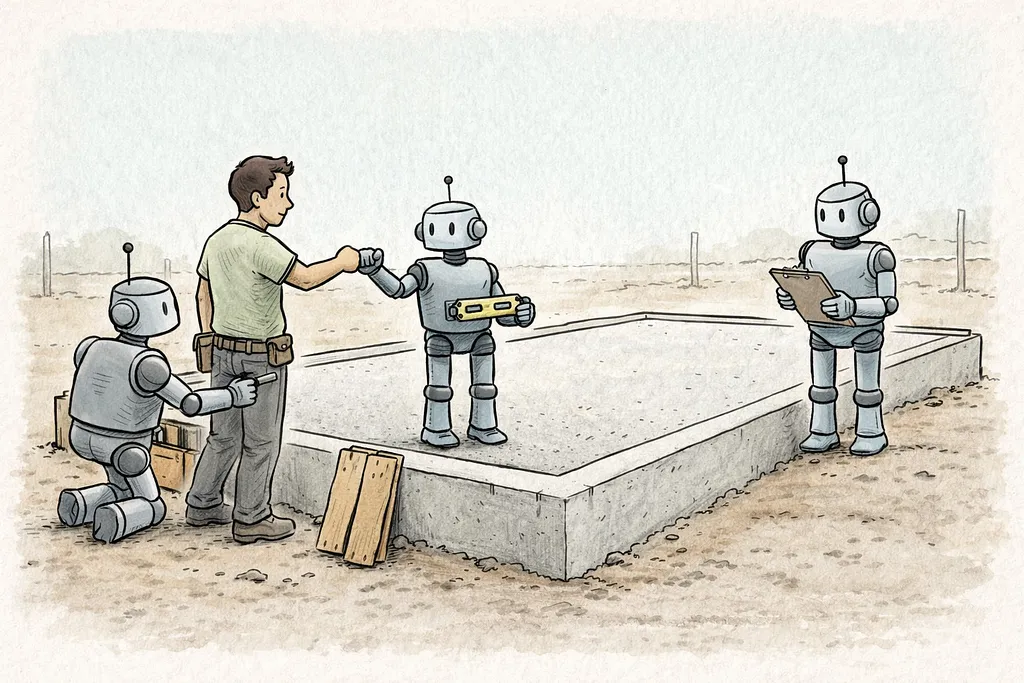
The Lead Developer and I held a mini fist-bump celebration.
What organizational expansion taught me
I hadn’t planned to formalize three new roles in the first week of January. But the work demanded it. Acting as CIO, PPM, and HoSR simultaneously meant none of those perspectives got proper attention.
The role briefings aren’t just documentation. They’re forcing functions. When the Head of Sapient Resources has a defined mission — “ensure coordination and health of sapient entities” — that work gets done instead of being squeezed out by whatever feels urgent.
The first week of 2026 was supposed to be catching up after the holidays. Instead it became an inflection point. Foundation complete. Roles formalized. Context preserved across chat transitions. Ready to build.