June 19, 2025
I was fresh off fixing our architectural drift issues and digging out of the PM-009 complexity hole and starting to feel like we’d learned our lessons about systematic development. Time to add some query functionality — just a simple “list projects” feature. How hard could it be? (Spoiler: this feature was still not yet working a month later, but let’s not get ahead of ourselves).
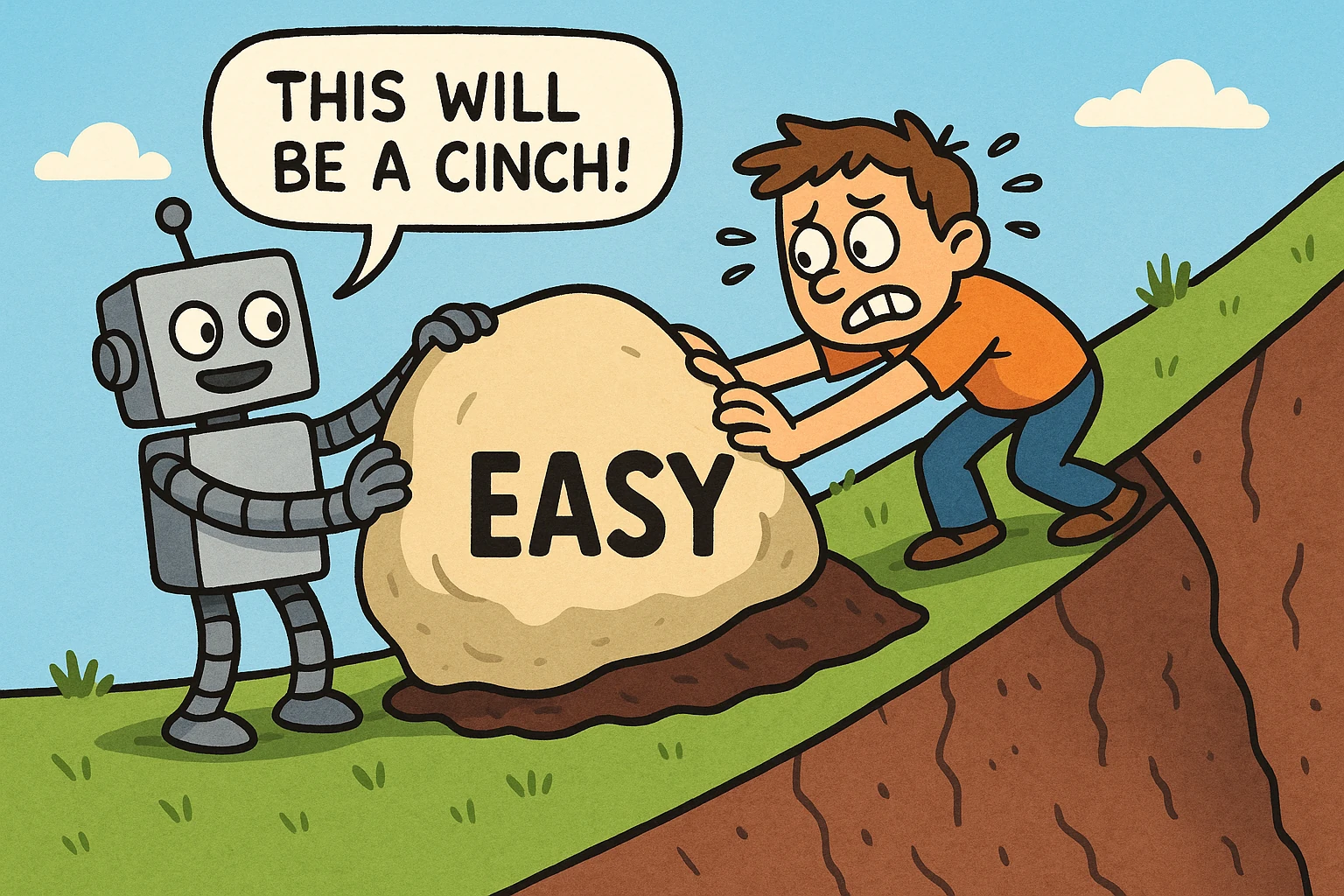
Then I tried to implement it using our existing workflow orchestration system and realized we were trying to force a data-fetching operation through an architecture designed for state-changing commands. If that all sounds like gibberish to you, trust me. It’s not good.
That’s when I discovered we had become the victims of something I may have mentioned already, “successful Prototype Syndrome” — when your proof-of-concept works so well that you don’t notice it’s become an architectural straightjacket.
When success becomes constraint
Our workflow orchestration system was beautiful. Task-based architecture, clean separation of concerns, perfect for complex operations like “create GitHub issue” or “analyze uploaded file.” Users could say things in natural language, we’d classify their intent, route it through the appropriate workflow, and execute a series of coordinated tasks.
It worked so well that we’d started putting everything through it, without really even thinking about it.
But when a user asks “what projects do I have access to?” they’re not requesting a workflow. They’re asking a question. And questions have different architectural requirements than commands.
The CQRS revelation
The breakthrough came when I realized we were trying to force queries through a command architecture: Commands change the state of things (creat a task, upload a file, save settings). Queries fetch data for you (list my projects, show the analytics, search for documents).
Commands need orchestration, error handling, rollback capabilities, audit trails. Queries need speed, caching, read optimization, simple error responses.
We’d built an excellent command system and then tried to make it handle queries too. Like using a Formula 1 race car for grocery shopping — technically possible, but missing the point entirely.
The moment of recognizing that “list projects” felt awkward because it wasn’t a workflow came from trying to implement something simple and feeling the architectural resistance.
The prototype success trap
Here’s what I learned about successful prototypes: they can become victims of their own success. Our workflow system worked so well for complex operations that we’d started assuming it was the right approach for all operations.
The prototype had solved one problem beautifully. We’d unconsciously decided it should solve all problems. Success can be as dangerous as failure if it prevents you from recognizing when you need different approaches.
The architectural forcing function
Trying to implement “list projects” through our workflow system revealed several forcing functions that didn’t make sense for simple queries:
- Intent classification: Why does “what projects do I have?” need sophisticated NLP?
- Task orchestration: Why does a database query need multi-step coordination?
- Workflow persistence: Why are we storing “list projects” requests as permanent workflow records?
- Error handling complexity: Why does a read operation need rollback capabilities?
Each individual piece worked correctly. Together, they were architectural overkill for a simple data fetch.
A query service
The solution emerged once we stopped trying to fit queries into command architecture:
# Command path (complex state changes):
Intent → Workflow → Orchestration → Tasks → Results

# Query path (simple data fetches):
Intent → Query Service → Repository → Results
Queries could bypass the entire orchestration layer and go directly to repositories. Faster, simpler, more appropriate complexity.
Sometimes the best architecture is the architecture you don’t need.
Growing documentation debt
Implementing the query service revealed another layer of “Successful Prototype Syndrome”: our documentation was describing the system we’d built, not the system we needed.
Every API endpoint went through workflows. Every user interaction required orchestration. Every feature was designed around the command pattern because that’s what our prototype had implemented successfully.
But a production system needs multiple interaction patterns, not just one really good one.
The “Successful Prototype Syndrome” pattern
Once I recognized the pattern, I could see it everywhere in software development:
- Authentication: “JWT tokens work great for API access, so let’s use them for everything”
- Caching: “Redis solved our performance problem, so let’s cache everything in Redis”
- Messaging: “Kafka handles our event streaming beautifully, so let’s put all inter-service communication through Kafka”
The successful prototype becomes the hammer that makes every problem look like a nail.
The three-tier collaboration effectiveness
What made this architecture session productive was our established collaboration pattern:
Claude Opus (Architecture): High-level pattern recognition and system design.
Claude Sonnet (Implementation): Detailed planning and step-by-step guidance.
Cursor Assistant (Execution): Code generation and syntax assistance
Each layer contributed its strengths without trying to do everything. Unlike our earlier drift experiences, this collaboration stayed within clear boundaries.
The documentation-first breakthrough
One of the most productive decisions was tackling documentation before implementation. We created ten comprehensive architecture documents:
- Architecture Overview
- Technical Architecture
- Data Model Document
- API Design Specification
- Pattern Catalog
- Development Guidelines
- Implementation Roadmap
- Test Strategy
- Dependency Diagrams
- Migration Guide
Documentation-first forced us to think through the query vs. command distinction before building it. And, honestly, if there’s one thing bots can do it’s write excruciatingly boring but detailed and accurate docs.
The CQRS-lite implementation
We implemented something called “CQRS-lite” — the essential separation without full event sourcing complexity:
Command side: Workflows, orchestration, complex error handling, audit trails
Query side: Direct repository access, simple error responses, optimized for speed
Not full CQRS with event sourcing and eventual consistency, but enough separation to prevent architectural confusion.
Sometimes you don’t need the full pattern — just the insight that drives the pattern.
Error-handling maturity
Implementing query services also forced us to mature our error handling beyond prototype-level responses:
Our prototype returned error messages only an engineer could love, code numbers, nothing actionable. Our production errors are still no paragons of user experience but at least they respect HTTP status codes (422/404/200) and provide actionable user messages.
Queries exposed error-handling gaps that complex workflows had been masking through their comprehensive exception management. These generic error message made the debugging twice as hard!
Simple operations revealed the need for simple, clear error communication.
Performance vs. complexity
The query service implementation taught me about the relationship between performance and architectural complexity:
Complex operations like most commands achieve performance through optimization, caching, and async processing. Simple operations such as queries gain performance through architectural simplicity
We’d been optimizing our workflow system for complex operations. But sometimes the best optimization is avoiding unnecessary complexity entirely.
AI system evolution
One insight from this session was recognizing that AI systems require different architectural thinking than traditional software. More of that fuzziness. Where traditional software is deterministic, can be scaled predictably, tends to have relatively stable interfaces, AI-using software seems to require ongoing calibration, “confidence monitoring,” evolving prompts, and a whole bevy of tweaks I’m still figuribng out.
Our prototype had worked with simple intent classification. Production required A/B testing frameworks, classification confidence monitoring, and user correction feedback loops.
The successful prototype hadn’t prepared us for the operational complexity of AI systems at scale.
The domain-first vindication
The query service implementation vindicated our domain-first architectural approach. We could add query paths without changing domain models because the domain logic was separate from the execution patterns.
- Domain models: Stayed stable across command and query implementations
- Service layers: Added query services alongside existing workflow services
- API layer: Extended with query endpoints while maintaining command endpoints
Good domain architecture enables multiple access patterns without fundamental changes.
The checkpoint-driven development value
What made this session successful — unlike our earlier complexity struggles — was checkpoint-driven development:
Checkpoint 1: Document the query vs. command distinction
Checkpoint 2: Implement basic query service
Checkpoint 3: Add error handling and HTTP semantics
Checkpoint 4: Update API documentation
Each checkpoint was small enough to complete and validate before moving forward.
A production-ready mindset shift
This session marked a transition from “works in happy path” thinking to “robust error handling with proper HTTP semantics” thinking.
Prototype mindset is about getting basic functionality working. Production mindset means handling edge cases, providing clear error messages, optimizing for operations.
The successful prototype had taught us to build features. Production required learning to build systems.
Architectural maturity benchmarks
Looking back, the ability to recognize and implement CQRS-lite showed architectural maturity. Instead of forcing new requirements into existing patterns, we could create new patterns appropriate to new requirements.
The successful prototype had been one really good pattern. The production system needed a toolkit of complementary patterns.
The compound learning effect
What struck me about this session was how lessons from our earlier architectural struggles compounded to make this session smoother:
- Multi-AI drift experience: Better coordination and explicit human oversight
- Complexity hole recovery: Systematic approaches and checkpoint validation
- CQRS implementation: Right-sized architecture for different problems
Each challenge had taught us something that made the next challenge more manageable.
Anti-prototype wisdom
The biggest insight from overcoming Successful Prototype Syndrome is developing “anti-prototype wisdom” — the ability to recognize when something that works well has become a constraint.
Questions to ask: Is this pattern appropriate for this problem? Are we using it because it’s right or because it’s familiar? What would a purpose-built solution look like?
Signals to watch for: Implementation that feels harder than it should, architectural resistance to simple features, complexity that doesn’t match problem complexity.
Another f’in’ “aha” moment
This session felt like the culmination of everything we’d learned about systematic architecture during the complex PM-009 implementation. We could recognize architectural problems early, implement solutions systematically, and document decisions for future reference.
The struggles with complexity and drift had taught us when to trust existing patterns and when to create new ones.