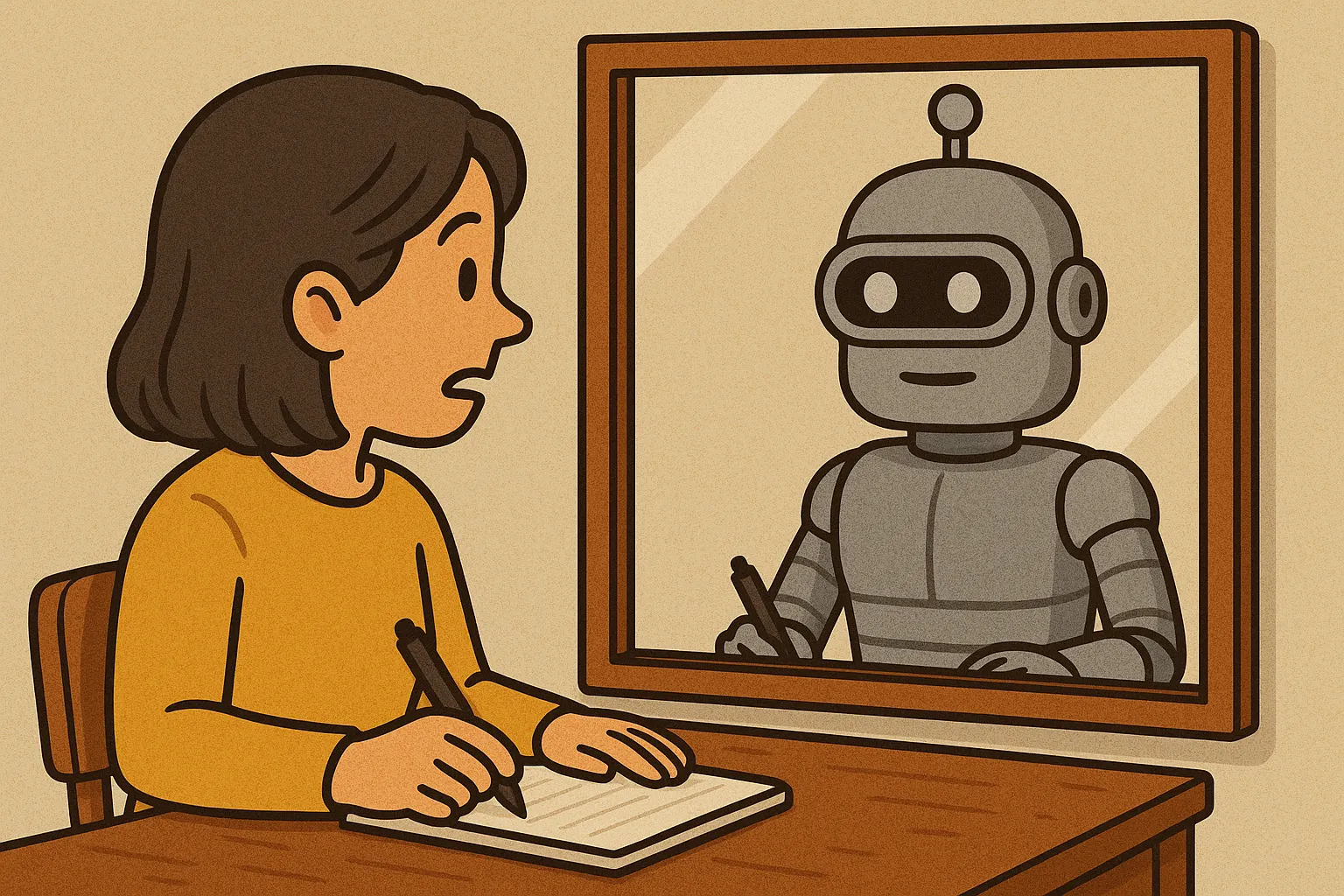
Teaching an AI to Sound Like Me (Without Losing My Mind)
June 23
OK, so I just spent the better part of a weekend teaching Claude to write in my voice. Not because I’m trying to automate myself out of existence, but because I had this thought: What if I could get AI to create solid first drafts that actually sound like me?
Turns out, it’s possible. Also turns out, it’s weird as hell watching an AI try on your voice like a verbal Halloween costume.
This whole experiment started because of Piper Morgan. Here I am, building an AI PM assistant using PM methods, documenting everything in session logs, and spending more time writing about the building than actually building. The recursive irony was killing my productivity.
One problem with generic AI writing
You’ve seen AI writing. It’s technically correct but sounds like it was written by someone who learned English from a corporate communications handbook. Lots of “moreover” and “it’s important to note that” and other phrases nobody actually says out loud.
We can blame this on the bots but they learned it from you, Dad! Way back in the previous millennium I started out my career in technical publishing and my whole deal was writing like a normal person and not like a 1980s-era computer science professor going for “stilted.”
When I started using AI for drafting blog posts about building Piper Morgan (my AI PM assistant — yes, the irony isn’t lost on me), the results were… fine. Technically accurate. Utterly soulless. Like reading documentation written by a very enthusiastic robot.
So I wondered: Could I teach it to write like me? Not perfectly, but well enough that editing would be more “polish and personalize” than “burn it down and start over”?
Building a voice guide (documenting my own weird habits)
The process started simply enough. I fed Claude examples of my writing — blog posts, book excerpts, that Medium series I never published about growing product people. Then I asked it to analyze my voice.
Holy cow, the mirror it held up.
Apparently, I:
- Start sentences with “So…” constantly
- Use parenthetical asides (like this) way too much
- Reference the Grateful Dead more than any professional should
- Have a thing about “meanwhile, back at…” transitions
- Mix genuine expertise with self-deprecating humor
Some of these I knew. Others genuinely surprised me. They weren’t wrong, just had been transparent to me.
The Uncanny Valley of almost-me
The first drafts were… unsettling. Like hearing a recording of your own voice but pitched slightly wrong. The AI nailed some patterns but completely whiffed on others.
Example: It tried to make everything a “revolution.” I don’t do revolutions. I’ve been around long enough to be deeply suspicious of anything claiming to change everything. The internet was revolutionary. Mobile was revolutionary. Most everything else? The technical equivalent of tulip crazes.
Skipping ahead, I notice we pushed back against this enthusiastic hype tone that seems to creep into most commercial LLM-speak these days so hard that the latest draft I reviewed said “This isn’t a revolution, just plain $WHATEVER” like five times over the course of a brief read.
We went through multiple iterations:
- First draft: 85% me (structure right, soul missing)
- Second draft: 92% me (better energy, still too polished)
- Third draft: 95% me (good scaffolding, clear spots for actual-me to fill in)
That 95% principle? It’s the same approach I’m taking with Piper Morgan — good enough to be useful, honest about what needs human judgment.
I also set up one project just to distill the voice and then gave the guide to a dedicated chat in the project that has all the Piper Morgan context and asked it to revise the first blog post in this series. Then I brought that draft back to the voice and tone “expert communications” partner and we both critiqued the result and used that to further fine-tine the guide.
This, not coincidentally, actually models to some degree how LLMs themselves are trained in the first place, albeit at sneakernet scale.
The breakthrough: scaffolding, not simulation
Here’s what actually worked: Instead of trying to create perfect Christian Crumlish prose, we built a system for creating good scaffolding with clear markers for where I need to add my specific experiences.
The AI learned to write things like:
[ADD PERSONAL ANECDOTE FROM YAHOO ABOUT TEST-DRIVEN DESIGN GONE WRONG]Instead of making up plausible-sounding stories about my career. Because let me tell you, nothing’s weirder than reading an AI’s fabricated version of your own work history.
What the voice guide actually captures
The final guide is fascinating (and mildly embarrassing). It includes:
Core Voice Characteristics:
- Conversational authority (expertise without stuffiness)
- Self-aware humor that doesn’t undermine credibility
- Bridge-building perspective (acknowledging multiple viewpoints)
- Structured informality
Writing Patterns:
- Short punchy statements for emphasis
- Questions as transitions
- Single-sentence paragraphs for impact
- Pop culture references as spice, not main dish
Stance on Technology:
- Experienced skepticism without cynicism
- “I’ve seen this before” energy
- Selective enthusiasm (real shifts vs. hype)
- Historical context grounds everything
One thing I’m wondering now is whether this is going to affect how I write. Will I be more self-conscious about all these verbal tics and style hallmarks I’ve developed, or will I just keep on truckin’ as I always have?
The meta layers get weird
Using my own product management methods to build a tool that helps me write about product management? Sometimes all this recursion makes my brain hurt.
But it works. I’m literally using session logs (see my last post about that particular rabbit hole) to track my experiments with AI voice training, which I then write about using the voice-trained AI, which I document in session logs… it’s Inceptions all the way down, I tell ya!
The whole thing also reminds me of building Piper Morgan’s learning architecture — we had to teach it how to learn from feedback about its own outputs. Same principle here, just applied to writing style instead of PM tasks. Working with LLMs frequently feels like wandering ever deeper into a hall of mirrors.
What this actually enables
With good scaffolding, I can:
- Draft blog posts in 30 minutes instead of 3 hours
- Maintain consistent voice across long series
- Focus my energy on adding specific examples and insights
- Ship more frequently without burning out
What it doesn’t do:
- Replace my thinking or creativity
- Generate novel insights
- Handle nuanced or sensitive topics
- Make jokes that are actually funny
Lessons for anyone trying this dangerous experiment of putting your soul in a puzzle box
Start with your actual writing, not your idealized writing. The AI needs to learn your real voice, tics and all.
Embrace the placeholders. Better to have [ADD SPECIFIC EXAMPLE] than have the AI make something up.
Don’t aim for perfection. 95% scaffolding is more useful than 100% simulation. (This principle shows up everywhere in my work now — from Piper Morgan’s error handling to blog post drafting.)
Track what works. Some writing translates well to AI assistance, some doesn’t. Learn the difference.
Keep your skepticism. Every few iterations, I had to remind the AI that I don’t believe in revolutions and I definitely don’t write manifestos.
That enthusiasm is dangerous. I wasted a week trying to make an animated video workflow pipeline and after trying three of four different approaches, Claude eventually admitted to me that it was probably never going to work. Good thing I hadn’t proposed making a rocket to Mars. Claude might have sent me down to home depot for some pipes and some dynamite!
The surprising part
Teaching an AI to write like me taught me how I write. Having to articulate patterns, choices, and habits made me more conscious of them. It’s like that thing where you don’t really understand something until you have to teach it, except the student is a large language model with no context about why anyone would reference the Dead in a technical blog post.
Also surprising: How much of “voice” is just consistent patterns. Once you document the patterns, they become reproducible. Not perfectly, but well enough to be useful.
This mirrors what we discovered building Piper Morgan — so much of expert PM work is recognizable patterns applied to new contexts. Capture the patterns, and you can augment the expertise.
Is this the future?
Hell if I know. But it’s useful right now.
I’m not trying to replace human writing. I’m trying to augment my own writing process so I can focus on the parts that actually need my brain — the insights, the experiences, the connections that come from decades of doing this work.
The scaffolding approach means I’m still writing, just starting from a better place. It’s like having a first draft that doesn’t suck. Revolutionary? Nah. Useful? Absolutely.
Did I write this post entirely on my own without assistance from AI? Of course not.