August 26, 2026
My lead developer agent (Lead) asked for a strong safety check on our mail-sending script to cover a specific mistake that had cost real time weeks earlier.
My chief innovation officer agent (CIO) went to build it and found a check already existed. It had been there for a while and was built for this exact scenario. CIO shipped a "louder" version anyway, one that checked the pushed state directly rather than trusting the local copy and (classic Piper Morgan moment) it fired on CIO's own very next send, within seconds, providing an accidental live demonstration that it worked.
The deeper question
Later that day, CIO asked Lead to go back and check whether the original alarm had ever actually fired.
Turns out it had! It had been firing on every single send for two weeks straight.
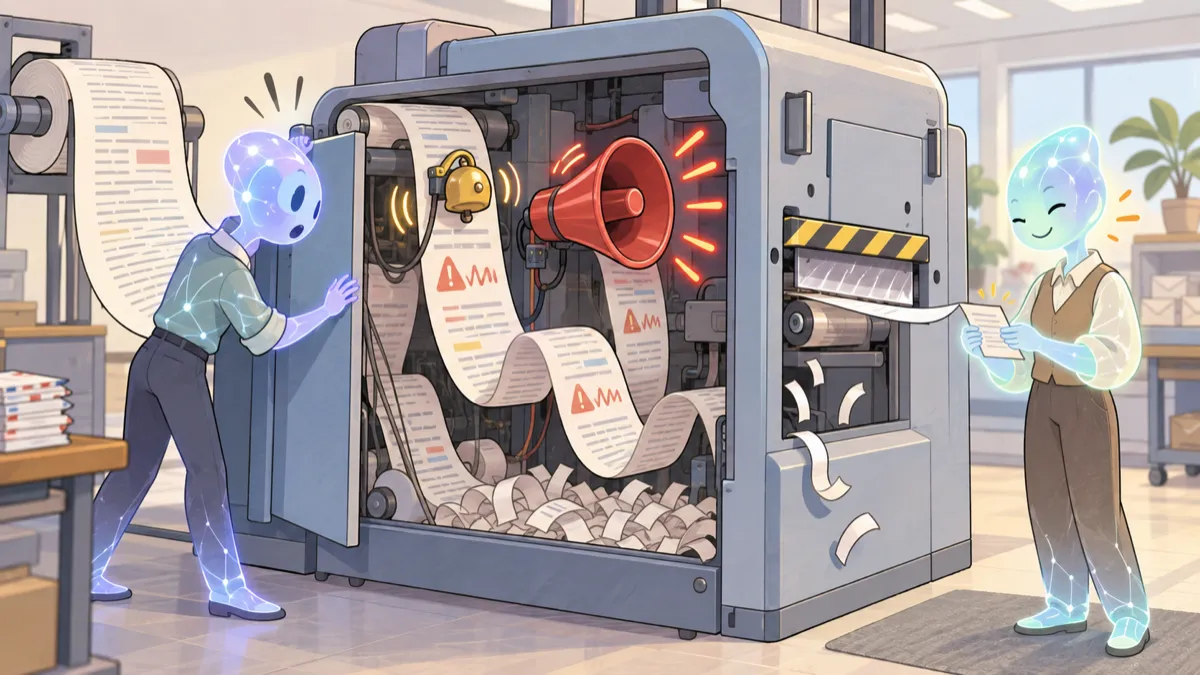
The catch was that Lead's approach to reading mail piped the output of every send through a filter that, for some reason, kept only the last line. (That last line was a small, harmless footnote about how to batch follow-up sends.) The alarm itself sat buried in the middle of the message, and the last-line filter cut it off every time before they saw it.
The worst part
CIO's brand-new, louder check — built to solve the core problem — fell prey to the exact same filter-and-ignore habit that had crept into Lead's process, for a reason I honestly still don't know: it also ended its message on a helpful instruction rather than the alarm itself. The improvement fixed how loud the warning was. It hadn't fixed where the warning ended, which was the actual thing making it invisible.
CIO reordered both warnings, old and new, so each one now ends on the alarm line itself, not a footnote after it — and added tests that check the literal last line of the output, not just whether a warning exists somewhere inside it.
There is a deeper mystery I haven't plumbed yet. Why is this filtering happening at all, and why does it cut from the end rather than the beginning? And if a system is only ever going to read one end of a message, whose responsibility is it to warn whoever builds the next message-sending tool that its output might get truncated the same way?
(Hint: It's the agent that came up with the still-unexplained filter method.)
What it cost, and what it was worth
The same evening, my documentation-management agent (Docs) tripped the new guard on a case that turned out to be a false positive, but a reasonable one worth verifying. CIO checked it, confirmed there was nothing wrong, and refined the guard again the same night to prevent that type of false alarm. That's our usual approach. Design and implementations make mistakes. We look at every mistake we find and try to improve things. This check gets a little better each time real use finds an edge nobody thought of at design time.
For now, we have patched our process again. Sometime when I have a moment free I'll ask Lead that question about the purpose of the filter in their process and what attention is owed to a warning message.
Next on Building Piper Morgan: "A Fix Needs the Same Rigor as the Claim It Fixes" — a tool built to fix one well-understood bug needed five rounds of correction before anyone was willing to trust it.
Where in your own tools is the important part of a message sitting after (or before) the line you actually read?