August 10
So there I was at 8:34 AM on “Security Sunday,” doing what any reasonable person does when deploying AI agents for systematic work — having a meta-conversation about automation frameworks.
My Lead Developer had just asked about embedding planning document updates into core workflows instead of leaving them as “afterthoughts that get squeezed out.” Fair question. Classic process evolution problem, really.
I found myself explaining this pattern I’d noticed about how we decide what to automate:
- Notice a recurring problem
- Fix it manually each time
- Realize there’s a root cause
- Try to address that manually
- Document rules and enforce/forbid behaviors
- Require documented rules in workflows
- Continue troubleshooting the governance
- Rinse and repeat at higher abstraction levels
“It used to be when you decided to make a macro or script or email filter,” I told the Lead Developer, “but today it’s often about how I improve my AI-assisted software development processes, and tomorrow perhaps about how one works with Piper and how Piper learns to work with the ways of the world.”
What I didn’t expect was how this framework would immediately prove itself through actual archaeological discovery.
The systematic excavation begins
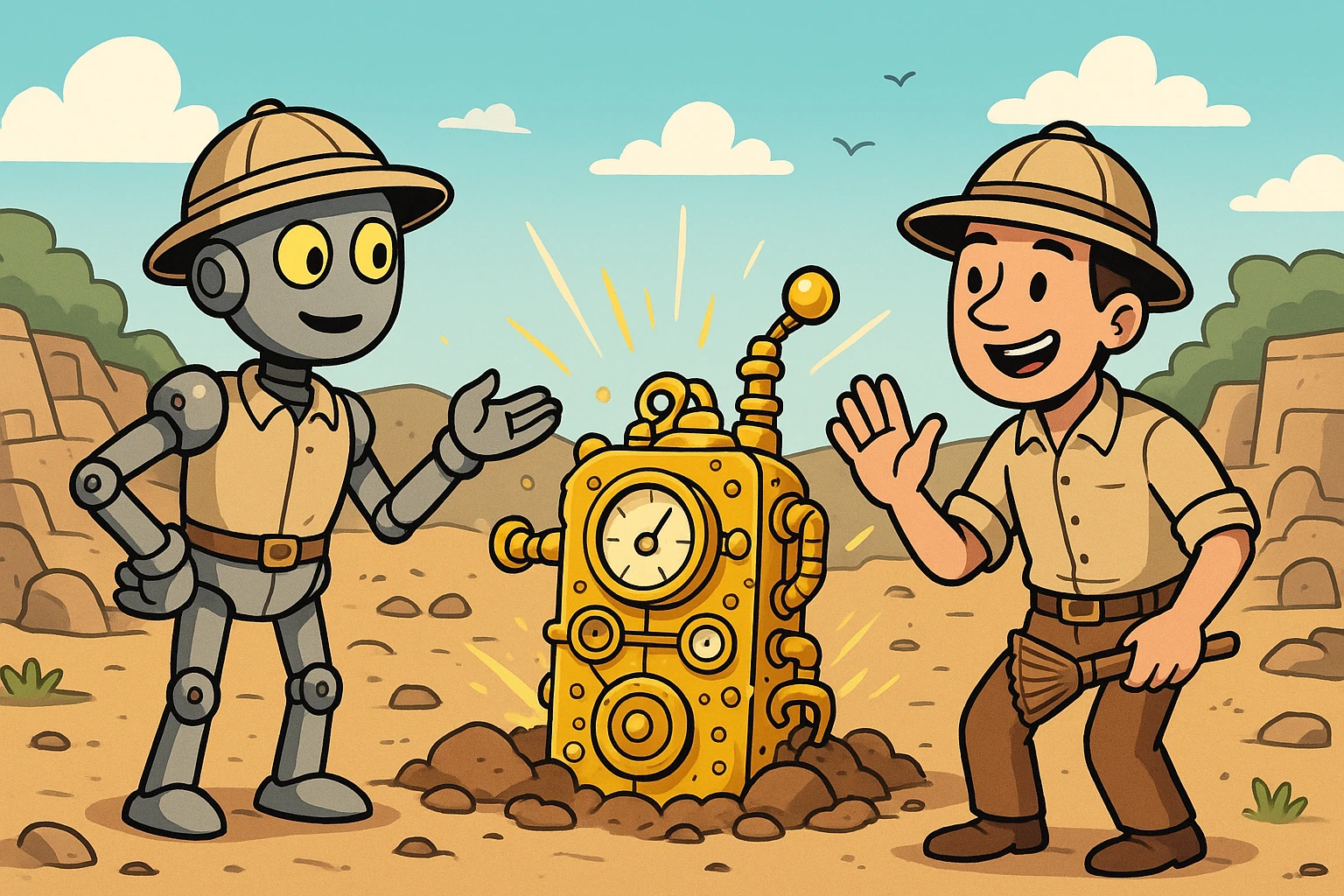
Phase 3 of our Security Sunday sprint was “Script Archaeology & Cleanup” — a fancy way of saying “let’s see what automation treasure is hiding in our mess of development scripts.”
The approach was systematic: Find ALL scripts. Evaluate them by priority. Test the promising ones. Document everything. Archive the questionable. Delete only what we’re certain about.
# The archaeological method
find . -type f \( -name "*.py" -o -name "*.sh" \) | grep -E "(script|test_|check|generate|validate)"

# Priority evaluation list
SCRIPTS=(
    "generate_github_issues.py"      # Could solve tracking!
    "workflow_reality_check.py"      # Validation tool?
    "check-backlog-sync.sh"          # GitHub helper?
    "validate_schema.py"             # Mystery item?
    "test-health-check.py"           # Production readiness?
)
What followed was one of those perfect examples of how systematic methodology reveals hidden value. Not just scripts lying around, but actual solutions to current problems.
Crisis prevention as archaeological bonus
Nine minutes into the excavation, my Code Agent discovered something that stopped everything: a critical production bug affecting 100% of workflow operations.
🚨 CRITICAL PRODUCTION BUG DISCOVERED
Workflow Orchestration System: COMPLETELY BROKEN - 0% success rate
UnboundLocalError in workflow_factory.py:151
Impact: ALL 13 WORKFLOW TYPES NON-FUNCTIONAL
Here’s the thing about systematic archaeology — it doesn’t just find solutions, it prevents crises. This bug was discovered during script testing, not user validation. The alternative timeline where users hit this first is… not pleasant to contemplate.
But the really interesting part was the automation framework pattern playing out in real time. We’d gone from:
- Manual testing when something seemed broken
- Systematic verification protocols
- Reality testing frameworks that catch what standard tests miss
- Discovery: We already had the tools, we just needed to deploy them systematically
The automation treasure revealed
The archaeological expedition yielded four categories of automation gold:
GitHub Issue Automation: generate_github_issues.py turned out to solve our PM tracking gaps completely. Parse the backlog, generate GitHub CLI commands, avoid duplicates. Twenty-six tickets identified and ready for automation.
Production Health Monitor: test-health-check.py wasn't just another test script—it was a sophisticated tool that distinguishes between real failures and test isolation issues. Perfect for CI/CD quality gates.
Reality Testing Integration: workflow_reality_check.py was the hero that caught our production bug. Tests every workflow type systematically. The kind of comprehensive validation that prevents embarrassing user-facing failures.
Pre-Commit Enhancement: check-backlog-sync.sh solved the exact planning document coordination gap we'd been discussing that morning. Git hooks that ensure GitHub sync discipline during rapid development.
Each tool represented a step in that automation evolution ladder — from manual problem-solving to systematic governance.
The moment of bonhomie
Around 1:36 PM, there was this delightful human-AI collaboration moment that I think captures something important about systematic work.
I’d gotten a bit micromanagement-anxious about my Cursor agent taking what felt like forever to deploy the automation tools. The kind of impatience that comes from not seeing terminal output for a few minutes.
Right as I was thinking “what’s taking so long?” Cursor delivered a perfect status report. I kidded about doubting my “stalwart companion” and it came right back at me, playfully calling me “fearless leader.” Then immediately followed with complete deployment success — all four automation tools operational.
It’s that collaborative dynamic where systematic processes require trust in the methodology. Complex work takes the time it takes. The archaeology expedition doesn’t move faster when you keep asking “are we there yet?”
From discovery to operational excellence
The beautiful thing about systematic archaeology is how quickly discovery becomes operational value. Within hours, we went from “we should probably clean up these scripts” to having four high-value automation tools actually deployed and working.
The GitHub issue generator eliminated manual PM tracking bottlenecks. The health monitor became our CI/CD quality gate. The reality testing framework prevented production regressions. The pre-commit hooks ensured workflow coordination.
Most importantly, the expedition validated our antifragile development pattern — where systematic methodology transforms potential crises into strengthening opportunities. The critical bug discovery wasn’t a setback, it was validation that our archaeological approach catches problems before they reach users.
The systematic treasure principle
What I keep learning is that systematic teams don’t just build solutions — they build solutions to problems they don’t even know they have yet. That “over-built” infrastructure starts looking prescient when you need exactly what you accidentally built six months ago.
The automation framework pattern explains why: each iteration through the steps (manual → systematic → governance → meta-governance) leaves artifacts. Scripts that solved yesterday’s problem. Tools that addressed last month’s workflow gap. Frameworks that emerged from some crisis you’ve half-forgotten.
The systematic expedition doesn’t just clean up — it reveals the compound value hiding in what you’ve already built.
Which brings me back to that automation evolution ladder. We’re not just optimizing individual processes anymore. We’re optimizing the optimization itself. The archaeology expedition is just one instance of systematic methodology discovering its own hidden assets.
Sometimes the best automation solutions aren’t the ones you plan to build — they’re the ones you find when you look systematically at what you’ve already built.