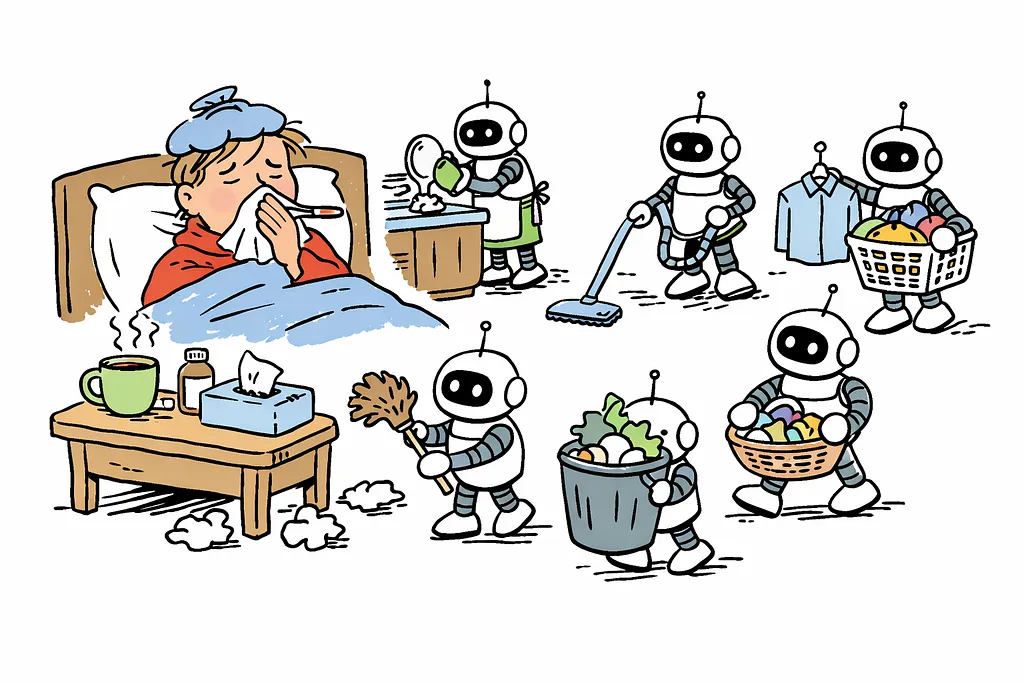
The Cathedral in Winter

February 10 to 13
By Monday, the flu had won. I’d been fighting it since feeling a pang in my sinus on Friday and it was established by Saturday, at which point I had started doing shorter sessions and lighter work on Piper Morham.
But Monday was different. I couldn’t focus. Couldn’t coordinate. Could barely follow what was happening in the session logs. So I did something I’d not done since starting this project nine month ago: I let go.
The cathedral without the architect
Monday produced exactly one agent session — a brief Documentation run to synthesize the previous day’s omnibus. I published a blog post that had been drafted earlier. Corresponded with Ted Nadeau about some GitHub questions. That was it.
Tuesday, I was still sick. But something strange happened.
The Documentation agent started a routine task: auditing ADR links to make sure all the cross-references still worked. Ted Nadeau had mentioned a broken link in passing, and this was the follow-up.
The audit found the broken links. Seven of them, across three files. Easy fixes. But then I noticed something in the agent’s report.
The dev/ directory was nearly empty.
2,155 files
The numbers didn’t make sense at first. We expected around 2,463 files in dev/. The audit found 308.
Eighty-seven percent of the files were gone.
Session logs — the daily record of everything we’d built — had dropped from 650 to 52. Gameplans — the detailed plans that guide every implementation — were completely gone. Not a single one remained.
Foggy as I was, I knew this was not good.
The investigation began immediately. Was this a fresh clone that hadn’t pulled the files? No — git reflog showed continuous history. Had someone deleted them? The evidence pointed to something more mundane and more preventable: a destructive git command, probably git checkout . or git restore ., run sometime around February 7th or 8th.
The dev/ directory was gitignored. It held working files, not committed code. When the restore command ran, git happily overwrote everything with… nothing. The files had never been committed, so there was nothing to restore them from.
Except there was.
Git archaeology
Git remembers everything — even files that were later gitignored. Every file that had ever been committed, even once, still existed somewhere in the repository’s history. The recovery command was ugly but effective:
git log --all --full-history --diff-filter=A --name-only --format='%H' -- 'dev/*' | \
  while read hash; do git checkout $hash -- dev/ 2>/dev/null; done
Translation: find every commit that ever added a file to dev/, and restore that file from that commit.
The result: 2,781 files recovered. More than we’d lost, because the archaeology surfaced files from months ago that had been deleted intentionally but were now restored as a side effect.
The afternoon became a cleanup operation. Sort the recovered files. Delete the ones we didn’t need. Compress the archives. Move things to their proper homes. By evening, dev/ had gone from 5.1 GB of chaos to 1.2 GB of organized structure.
The institutional memory was intact.
The December bug
Wednesday brought a different kind of discovery.
Dominique Derosena — a new alpha tester referred by my 18F colleague Magdaline Derosena — was setting up Piper on Windows. Fresh machine, following the alpha tester instructions. He ran the setup script.
It failed immediately.
Not after a few steps. Not with a subtle error. Immediately. The script printed its opening message and then… stopped.
The bug was in the batch file structure. Helper subroutines used exit /b to return to the caller. But in Windows batch files, exit /b inside a subroutine doesn't return — it exits the entire script. The correct command is goto :eof.
This bug had existed since December 2025. Two months. Through Ted Nadeau’s extensive Windows testing — fourteen issues filed and fixed. Through multiple releases. Through the entire alpha program.
I wonder why Ted hand’t run into it?
The answer was in his issue reports. Ted’s fourteen issues focused on requirements.txt conflicts, missing migrations, documentation gaps. All real problems. But nothing about the setup script failing on first run.
He must have hit the failure, shrugged, and switched to manual setup, or kust stopped at that point. Then filed issues about everything else he encountered. Maybe, the script failure was so immediate, so total, that it didn’t even register as a bug worth reporting — just an obstacle to work around.
Pairing with Dominique, as he set things up, coming in fresh, we caught it and logged the issue.
Systematic prevention
The Windows bug led to a broader question: why wasn’t this caught automatically?
The answer was uncomfortable. We had no Windows CI. Our continuous integration tested on Linux and macOS. Windows was… assumed. If a batch file was syntactically valid, we figured it would work.
By Thursday afternoon, we had:
- A fixed setup script (restructured,
goto :eofreplacingexit /b) - A Windows CI workflow (runs on every change to batch files, PowerShell scripts, or requirements.txt)
- A Windows smoke test script (for alpha testers to validate their setup manually)
The gap that had hidden for two months was now systematically covered.
What the flu revealed
I was sick for most of this week. Genuinely, frustratingly, can’t-think-straight sick.
And the cathedral kept building itself.
Not autonomously — agents still needed prompts to start, guidance when stuck, decisions when options diverged. But the infrastructure we’d built over months proved itself. The omnibus logs captured what happened even when I couldn’t follow along in real time. The audit protocols surfaced the file loss before it became permanent. The methodology — investigate first, fix second — led to systematic prevention rather than one-off patches.
By Friday, I was still recovering, but was able to make the rounds of all eight leadership agents for the weekly review — Chief of Staff, Architect, CIO, CXO, PPM, HoSR, Communications Chief, and the Lead Developer’s notes. They synthesized seven days of work across twenty-two sessions. Their conclusion matched what I’d been feeling all week: the infrastructure held.
The files that nearly vanished taught me something about institutional memory. The December bug taught me something about fresh eyes. And the flu taught me something about cathedrals: the good ones don’t need their architects present every day. They’re built to stand.