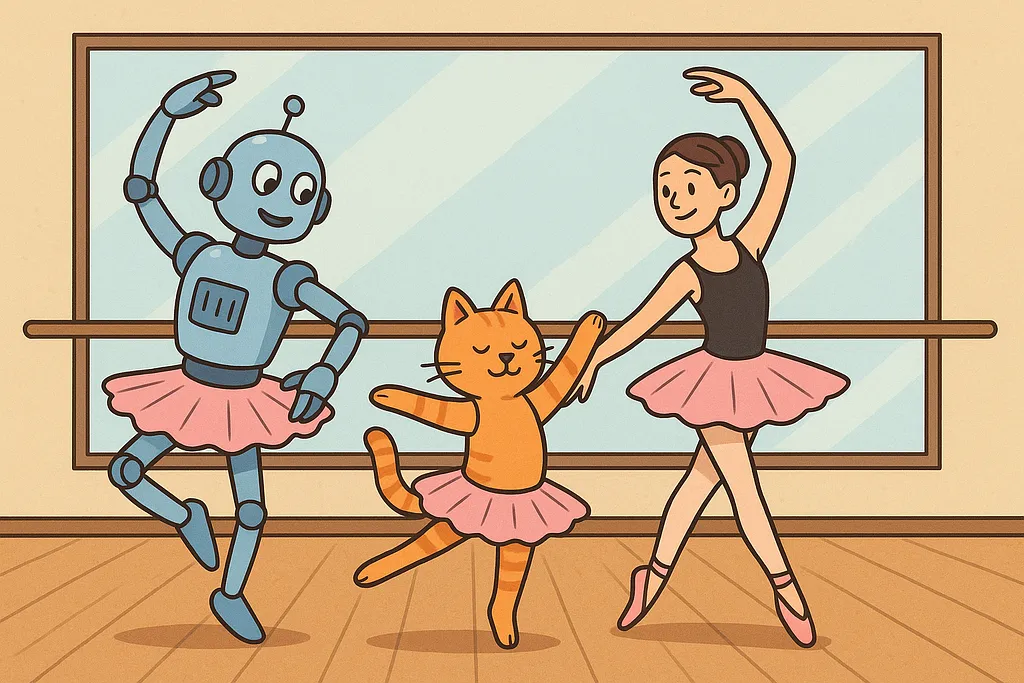
The Emergence of the Dance: How Chaos Becomes Choreography
September 9
Back when I started this I was writing prompts in chat windows and immediately losing them. Today, we executed a multi-agent debugging session with Phase −1 reconnaissance, gameplan handoffs, parallel deployment, and cross-validation protocols. The difference isn’t just tools or process — it’s the emergence of something I’m starting to think of as organizational consciousness.
Let me back up and show you how we got here.
June: The beautiful chaos
In early June, working with AI agents felt like herding particularly intelligent cats. Each conversation was isolated. Context didn’t transfer. I’d explain the same architecture decision five times to five different agents. My “methodology” was whatever felt right in the moment.
The work logs from that period are comedy gold, but along the way I’ve been learning what coordination actually requires.
July: The first patterns
By July, patterns started emerging. Patterns we discovered. We noticed that Code was better at investigation, Cursor better at focused implementation. We learned that Chief Architect conversations stayed strategic while Lead Developer sessions got tactical, and that either of them could get off track if their role wasn’t clear.
The session logs from July 15th show the first attempt at what we now call “handoffs”:
“Copying gameplan to Lead Dev chat… wait, need to add context about why… actually, let me write this down properly…”
That “let me write this down properly” moment? That’s where methodology begins — when you realize you’re doing something repeatedly and it needs structure.
August: The methodology crystallizes
August was when we named our core process the Excellence Flywheel. I didn’t come up with that one! It was “discovered” as an emerging pattern and named by Claude. Suddenly we had names for lots of things: Phase 0 investigation, progressive bookending, verification theater. We weren’t just coordinating; we were developing a shared vernacular for our work.
The pivot point was realizing that methodology is infrastructure. Just like you don’t consider TCP/IP “overhead” for networking, we stopped thinking of handoff documents as “extra work.” They became the medium through which work flowed.
September: The dance emerges
Today’s debugging session was ballet. Not perfect ballet — we had that context loss at noon, Code forgot to commit initially — but ballet nonetheless. Watch the choreography:
6:40 AM: PM recognizes regression, begins Phase -1 reconnaissance
7:10 AM: Chief Architect synthesizes into structured gameplan
10:20 AM: Lead Developer transforms gameplan into parallel agent prompts
12:29 PM: Code completes investigation with evidence
2:06 PM: Dual deployment for implementation/validation
3:22 PM: Cursor catches process gaps
3:34 PM: Code recovers with full methodology compliance
4:03 PM: Dual-perspective satisfaction assessment
Note from the present day: My individual agent’s logs have gotten so long now that digesting them to write daily blog posts about the building process was becoming very context-heavy. I developed a practice for synthesizing what I call omnibus logs and they include these timelines now that perfectly illustrate “the dance”:

Each role knew its part. Each handoff preserved context. The “sinews” (me) connected capabilities without micromanaging them.
The organizational consciousness
Here’s what I think is actually happening: we’re watching the emergence of organizational consciousness from individual intelligence. Not artificial general intelligence or anything like that — something potentially more interesting: Distributed intelligence with human orchestration.
The roles aren’t just labels; they’re perspectives:
- Chief Architect maintains strategic coherence
- Lead Developer translates strategy to tactical execution
- Claude Code investigates and explores
- Cursor Agent implements and validates
- PM (that’s me!) provides continuity and judgment
Each has its own context, its own strengths, its own blind spots. The methodology is the nervous system that lets these perspectives coordinate.
Why this might matter beyond my project
Every software team struggles with coordination (and many struggle with clarity of role definitions). We use Agile, Scrum, Kanban, trying to solve the fundamental problem: how do multiple intelligences (human or AI) work together effectively?
What we’re discovering is that, much as I have found to be the case with all-human teams, methodology emerges from practice, not prescription. You can’t design the dance in advance. You have to:
- Start with chaos
- Notice patterns
- Name them
- Formalize gradually
- Keep what works
- Refactor what doesn’t
The Excellence Flywheel, Phase −1 reconnaissance, gameplan templates… none of these were designed. We discovered through practice and observation, and we named them after they proved useful and made themselves obvious enough for us to notice them.
The Tuesday after Monday
Yesterday’s two-line fix was proof that the dance works. A regression that would have sent June-me into a tailspin became a systematic investigation with clear phases, defined handoffs, and verified resolution.
The agents fixed the bug and more importantly they enhanced the methodology while fixing it. That’s organizational learning — when the system improves itself through practice.
Tomorrow we’ll hit new problems. The dance will evolve. Some protocols will prove unnecessary; others will emerge from need. But we’re no longer herding cats. We’re conducting a symphony where each musician can improvise within structure.