December 25, 2025
We had a problem: 44 new canonical queries to investigate. Each one needed infrastructure assessment, blocker identification, implementation complexity rating. Traditional approach: investigate them one by one, maybe three or four per session.
At that pace, the reconnaissance alone would take two weeks.
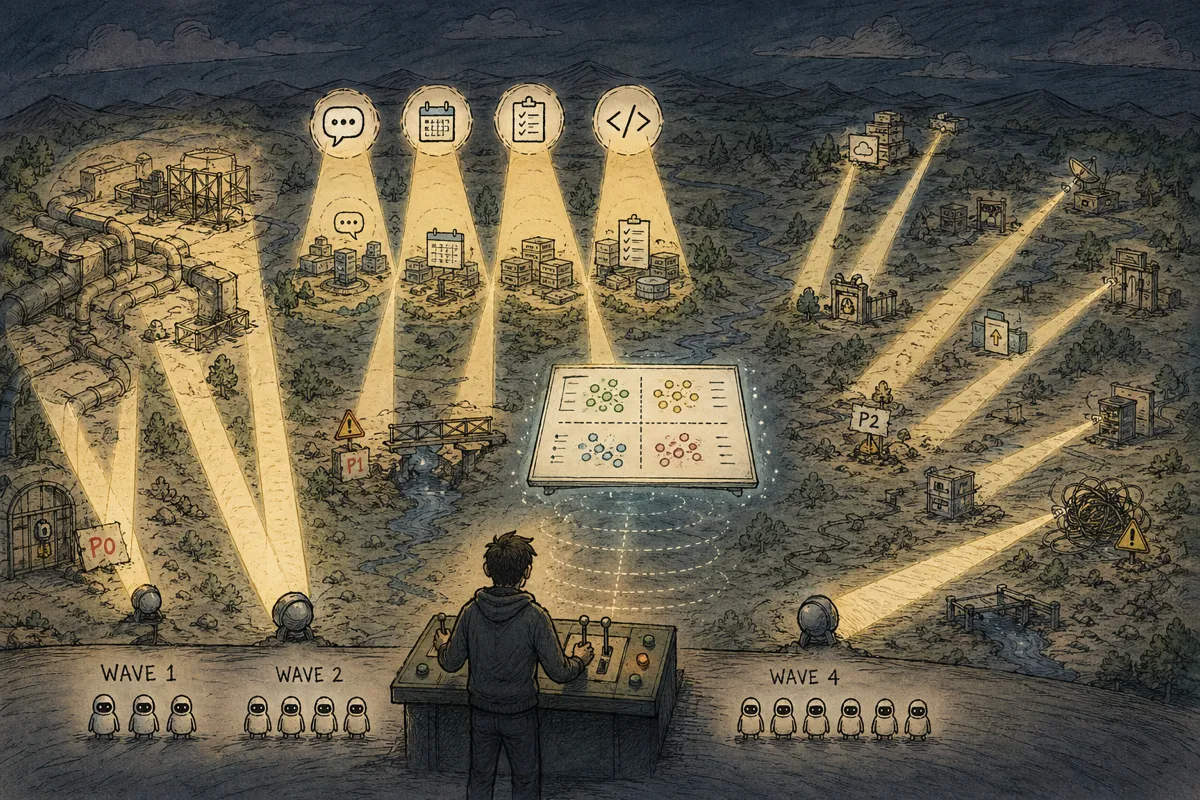
Instead, we deployed 13 subagents across 4 waves in a single 90-minute session. All 44 queries investigated. Complete infrastructure map. Priority matrix created.
The wave structure
Wave 1: Core Infrastructure Audit (3 agents)
- Intent Router Auditor: 8 intent categories mapped, coverage percentages calculated
- Integration Inventory: 6 integration routers catalogued, 200+ methods found
- Repository Method Scan: 97 methods across 6 repositories analyzed
These three agents established the baseline. What existed? What was complete? Where were the foundations solid?
Wave 2: Category Deep Dives (4 agents)
- GitHub Operations: 8 queries mapped, complexity breakdown (2 LOW, 4 MEDIUM, 2 HIGH)
- Slack Operations: 5 queries mapped, infrastructure complete except LLM summarization
- Calendar Operations: 7 queries mapped, critical OAuth scope constraint identified
- Todo Operations: 4 queries mapped, critical blocker found (hardcoded user_id)
These four agents worked in parallel, each focused on a specific integration category. They didn't need to coordinate—they were examining independent infrastructure.
Wave 3: Gap Analysis (synthesis)
- Priority matrix created: Phase A (5 LOW), Phase B (11 MEDIUM), Phase C (8 HIGH), Phase D (12 blocked)
- Critical blockers documented with priority levels (P0, P1, P2)
Wave 3 synthesized the category deep dives into actionable prioritization.
Wave 4: Remaining Categories (6 agents)
- Help/Capability System, Activity/Audit Logging, Notion Write Operations
- Notification Infrastructure, Conversation Serialization, File Upload
- Each assessed independently, blockers identified, readiness scored
Why it worked just fine
The key insight: investigation parallelizes well. Analysis doesn't require shared state. Each agent can examine a portion of the codebase without coordinating with others.
Implementation is different. Two agents trying to modify the same file create merge conflicts. Two agents implementing related features need to coordinate on interfaces.
But two agents reading different parts of the codebase? They can run simultaneously without collision.
A taxonomy for blockers
Wave 3 produced something useful beyond the priority matrix: a blocker taxonomy.
- P0 (blocks all): Problems that prevent any query from working. User_id hardcoded as "default" was P0—it broke multi-user isolation across everything.
- P1 (blocks category): Problems that prevent a category from working. Calendar OAuth readonly scope was P1—it blocked all scheduling features.
- P2 (nice to have): Problems that degrade experience but don't block core functionality. Missing LLM summarization in Slack was P2.
This taxonomy separated complexity from criticality. A query could be easy to implement (LOW complexity) but blocked by a P0 issue. Another could be hard to implement (HIGH complexity) but have no blockers.
The priority matrix combined both dimensions.
When to use this model
Multi-wave investigation works when:
- The problem space can be partitioned cleanly (categories, modules, time periods)
- Each partition can be analyzed independently
- Synthesis can happen after parallel analysis completes
- You need breadth more than depth initially
It doesn't work when:
- Agents need to coordinate during investigation
- Analysis requires iterative refinement based on early findings
- The partitions have hidden dependencies
Deploying multiple agents to fan out and research a problem has since become a routine part of my work habits, something Claude agents do very comfortably using their subagent capabilities, and clearly part of where this sort of tooling stack is headed in the future, as a matter of course.
Seeing from all angles at once
90 minutes of parallel investigation saved an estimated 10 days of sequential work (at least in trad-human terms) and, more importantly, helped develop a more complete picture.
Sequential investigation would have answered questions as they arose. Parallel investigation answered questions we hadn't thought to ask yet. The OAuth scope constraint. The hardcoded user_id. The missing router methods.
Sometimes you work from a checklist when you know what you're looking for, but all of these discoveries emerged from the comprehensive coverage achievable with this multi-directional approach.
Next on Building Piper Morgan: Verify the Paraphrase, covering a work stream review from April 19 based on incomplete source material.
Have you found ways to parallelize investigation work? What made it succeed or fail?