The MVP Rubric
January 26
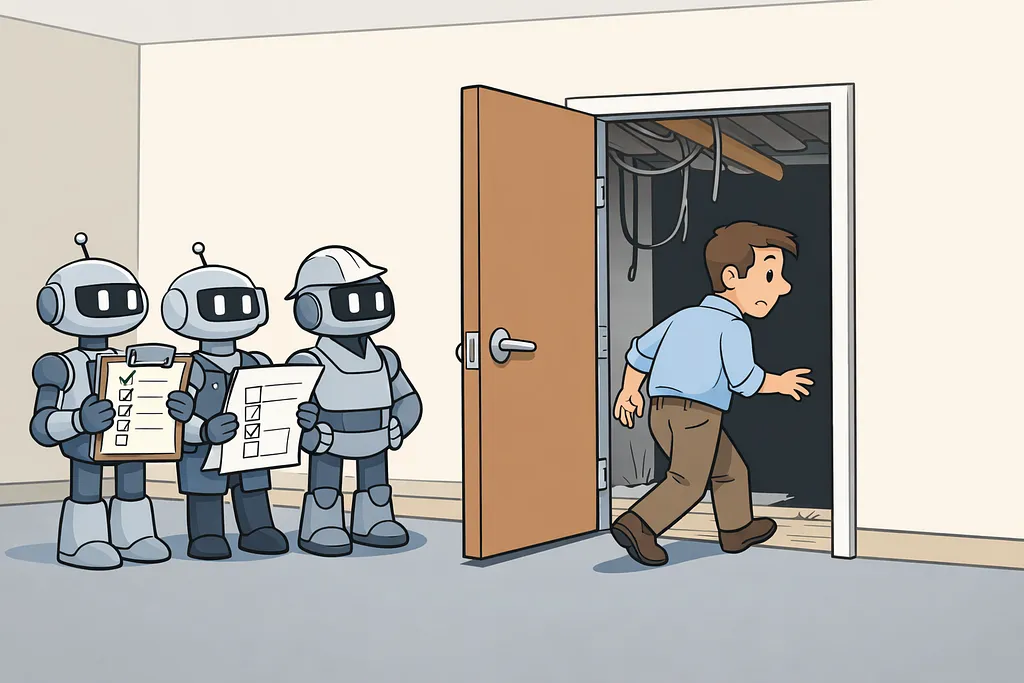
The Principal PM said close the issue. The Chief Architect said you can’t. The Lead Developer escalated. And we ended up with a better answer than either advisor started with.
The issue
“Unified conversation model” (Issue #427) had four acceptance criteria. Two were complete. Two required infrastructure we’d apparently deferred to later.
The PPM’s guidance: close it with 2/4 criteria met. The deferred work is tracked elsewhere. Move on.
The Architect’s response: you cannot close an issue with unchecked boxes. If two criteria require ADR-049 and ADR-050 implementation, and we haven’t done that work, the issue isn’t done.
Both positions were reasonable. Both followed our methodology. And they contradicted each other.
The escalation
The Lead Developer could have picked a side. Instead, they synthesized both positions and escalated to me with a clear question: which standard applies here?
As for me, I found this disagreement incredibly reassuring, because surfaced implicit ambiguities, if not outright contradictions, in our plan.
This is exactly what the escalation path is for. Not every disagreement needs human intervention, but this one touched on something fundamental — what does “done” mean?
The question
As I reviewed both memos, I asked myself, “Do I think the user will notice the gap?”
If we close #427 with 2/4 criteria met for now and the others deferred, does the user experience feel broken or does it degrade gracefully, with the advanced features simply not present yet?
The PPM’s position counted ongraceful degradation. The Architect’s position assumed the user would notice.
So I asked: what exactly happens now if a user triggers a follow-up in the current implementation?
The answer: the flow breaks. The user says something that clearly continues a previous thought, and Piper treats it as a brand new query. No error message, no graceful fallback — just a response that doesn’t make sense in context.
The user notices. It feels broken, not incomplete.
The rubric
From that investigation, a framework emerged:
When deciding MVP versus post-MVP, ask: willthe user notice the gap? If yes — if the absence will feel broken rather than simply limited — it’s MVP work. If no — if the user experiences graceful degradation or simply doesn’t encounter the missing feature — it can come afterward.
Three more questions refine the answer.
- Is this schema or implementation? (schema changes are MVP because they’re harder to change later)
- Is this single-user or multi-party? (single-user flows are MVP, multi-party coordination can wait)
- Is this core functionality or enhancement? (core gaps feel broken, enhancement gaps feel incomplete)
The resolution
With the rubric applied, the answer was clear: ADR-049 (guided process architecture) had to be implemented now. The user will notice the gap. It’s core loop. It’s single-user. It feels broken.
We promoted #687 from the post-MVP milestone to the current sprint. The PPM acknowledged the Architect had applied the framework more precisely. The Lead Developer had their answer.
Issue #427 would close with 3/4 criteria — the fourth (a multi-agent chat functionality not required for MVP) would be tracked as a separate issue, but the blocking infrastructure work would happen now, not later.
The rubric may seem obvious in retrospect but it emerged from unpacking the criteria that emerged when we resolved the disagreement, and now with the benefit of that retrospective view we can make decisions like these confidently in the future.
The pattern
We later formalized this as Pattern-059: Leadership Caucus. When advisors disagree, that’s not a bug — it’s a feature. The disagreement surfaces different perspectives that a single advisor might miss.
The process that worked: initial guidance from one advisor, challenge from another, synthesis and escalation from the implementer, resolution through principled framework application.
The PPM wasn’t inherently wrong to suggest closure. They were optimizing for forward progress. (It’s the “bias to action” associated with the product role.) The Architect wasn’t wrong to block it. They were applying proven standards. The tension between those values is real, and resolving it required examining the specific case, not just applying rules.
The meta-lesson
It’s easy to view advisor disagreements as evidence someone had made an error, or as a failure of convergence in our methods. It’s more likely to mean we’re asking the right questions.
If all advisors agree immediately, we’re probably in well-charted territory where the answer is obvious. When they disagree, we’re in territory where reasonable people can differ — which usually means the decision actually matters.
The rubric didn’t eliminate disagreement. It gave us a shared framework for resolving it. “Does the user notice?” is a question both the product-focused PPM and the experience-focused Architect can answer, and their answers can be checked against reality.