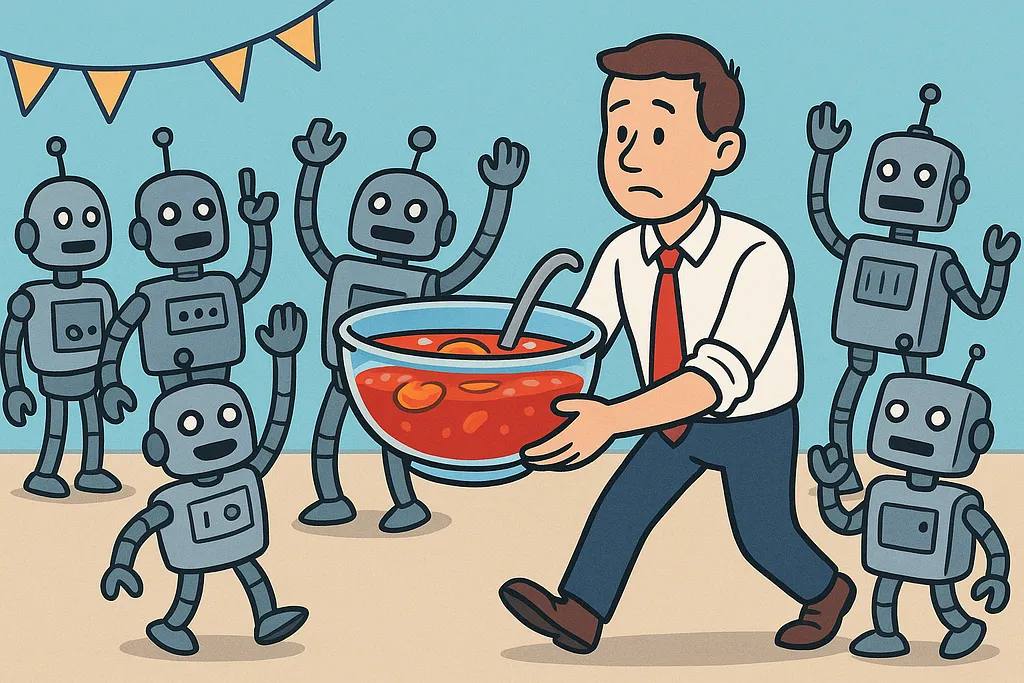
The Punchbowl Principle: When Good Enough Really Is Good Enough
September 4 to 6
There’s a moment in every product development cycle when you have to take the punchbowl away before the party gets sloppy. The features are working, the core value is delivered, and the team starts eyeing all the cool things they could add. That’s exactly when a good PM steps in and says “we ship what we have.”
I’ve been thinking about this a lot lately as we’ve been building Piper Morgan. Not because we’re ready to ship anything to users yet, but because we keep hitting these internal “punchbowl moments” where we have to decide: polish this further, or move on to the next thing?
The September 4th coffee question
A few days ago, I asked my Chief Architect over morning coffee: “Are we closer to MVP than when we started the week, or did the methodology work take us sideways from the goal?”
It’s a fair question. We’d spent significant time building systematic processes, templates, and coordination frameworks. On the surface, that looks like not-shipping. But my gut feeling was different: “I don’t know if we are closer in time than when we expected to be, but I think we are getting closer in fact, if that makes any sense.”
The methodology work wasn’t taking us sideways — it was building foundation that would make everything else possible. But I was also aware of the risk. As I told the architect: “I want to practice discipline as a PM, take the punchbowl away before the party gets sloppy, and make sure we don’t mistake ‘oh that would also be cool’ for core MVP functionality.”
From linear to parallel thinking
That conversation sparked a realization about how we were thinking about our roadmap. We’d been using the typical startup approach: a linear sequence of now/next/later items. But that forces everything into dependencies that might not actually exist.
What if instead we thought in parallel tracks, each with their own “punchbowl line”?
Track 1: Methodology → Punchbowl line: 15-minute setup works reliably
Track 2: Core Workflows → Punchbowl line: Two complete user journeys
Track 3: User Experience → Punchbowl line: Non-technical user succeeds
Track 4: Infrastructure → Punchbowl line: Daily single-user reliability
Track 5: Knowledge Management → Punchbowl line: Agents stop making wrong assumptions
Each track can progress independently, with periodic alignment checks. More importantly, each track has a clear “good enough” threshold. Beyond that line lives “would be cool” territory, not “core MVP” territory.
The bootstrap threshold
Yesterday we hit one of those thresholds. Our Morning Standup feature crossed from “architecturally complete but returns null content” to “pulls real data from my actual accounts and reports meaningful insights.” When I ran the command, it showed 10 recent accomplishments — including the very commits we’d made to fix the Morning Standup itself.

That recursive moment — Piper Morgan reporting on its own development — felt like crossing a legitimate threshold. Not the final destination, but a genuine “closer in fact” milestone.
The discipline of systematic shipping
Here’s what’s interesting about the punchbowl principle in practice: it requires systematic thinking to implement well. You can’t just arbitrarily decide “this is good enough” — you need frameworks for recognizing when you’ve hit genuine utility versus when you’re just tired of working on something.
Our multi-track approach helps with this. Instead of one big “are we ready to ship?” decision, we get multiple smaller “has this track hit its punchbowl line?” decisions. The methodology track hit its line when our 15-minute setup started working reliably. The core workflow track hit its line when Morning Standup started returning real data.
Each threshold creates enabling conditions for the other tracks to accelerate. Better methodology makes feature development faster. Working features reveal what infrastructure really needs. Good infrastructure enables more ambitious features.
Some of that good old meta-recursion
There’s something beautiful about using the methodology you’re building to improve the methodology itself. We’re applying systematic PM thinking to the problem of building systematic PM tools. We’re using multi-agent coordination to develop multi-agent coordination patterns. We’re using the punchbowl principle to decide when our implementation of the punchbowl principle is good enough.
It’s punchbowls all the way down! (up?)
It’s recursive in the best possible way — each cycle up the ladder makes the next cycle faster and more reliable.
Knowing when to climb
The hardest part of the punchbowl principle is recognizing when you’ve reached genuine utility rather than just technical completion. Features can work perfectly in isolation while delivering no real value. Systems can be architecturally beautiful while being practically useless.
The test we’ve been using: does this thing do real work for real people in real situations? When Morning Standup started pulling actual commits from actual repos and synthesizing them into actually useful daily briefings, that was a real threshold crossed.
Not the finish line, but a legitimate rung on the ladder.
The enabling paradox
Here’s the paradox of good foundation work: it looks like not-shipping, but it enables everything else to ship faster. Our methodology track felt like overhead for weeks. Now it’s delivering 95% efficiency gains in development cycles. Our systematic approach to building workflows felt slow when we were learning it. Now it means the second workflow will be 3x faster to implement.
Taking the punchbowl away doesn’t mean shipping incomplete work — it means shipping complete-enough work and moving to the next enabling layer.
Process as product feature
For anyone building AI-augmented tools, this might be especially relevant. The methodology isn’t separate from the product — it’s a core product feature. How you coordinate with AI agents, how you verify their work, how you prevent verification theater, how you maintain context across complex workflows — these aren’t development overhead, they’re differentiating capabilities.
Users don’t just want AI tools that work sometimes. They want AI tools that work systematically, that show their reasoning, that fail gracefully, that get better over time. The “showing your work” capability is the product, not just the development approach.