The Thread and the Weave

February 5–9
The day after finishing the Pattern Sweep, I asked a question. “Can you check on this one failing test?” It was a Notion configuration test, #782. One test. Should have been straightforward.
“All 19 tests fail,” the Lead Developer reported back. “Not just one.”
The thread that wouldn’t stop
The test failure traced to a missing fixture — TEST_USER_ID wasn’t being set, so the config service couldn’t isolate properly. Four minutes to fix. But that fix revealed something else.
While investigating a History Sidebar issue — a new feature from the MUX sprints that wasn’t behaving as expected — the Lead Developer found something worse: cross-user session bleed. Under certain conditions, User A could see data that belonged to User B. Not passwords or credentials — conversation metadata. But still. A user isolation bug in what’s supposed to be a multi-tenant system.
The morning had started with one failing test. By afternoon, we’d found five interconnected bugs. By evening, we’d closed thirteen issues and shipped v0.8.5.2.
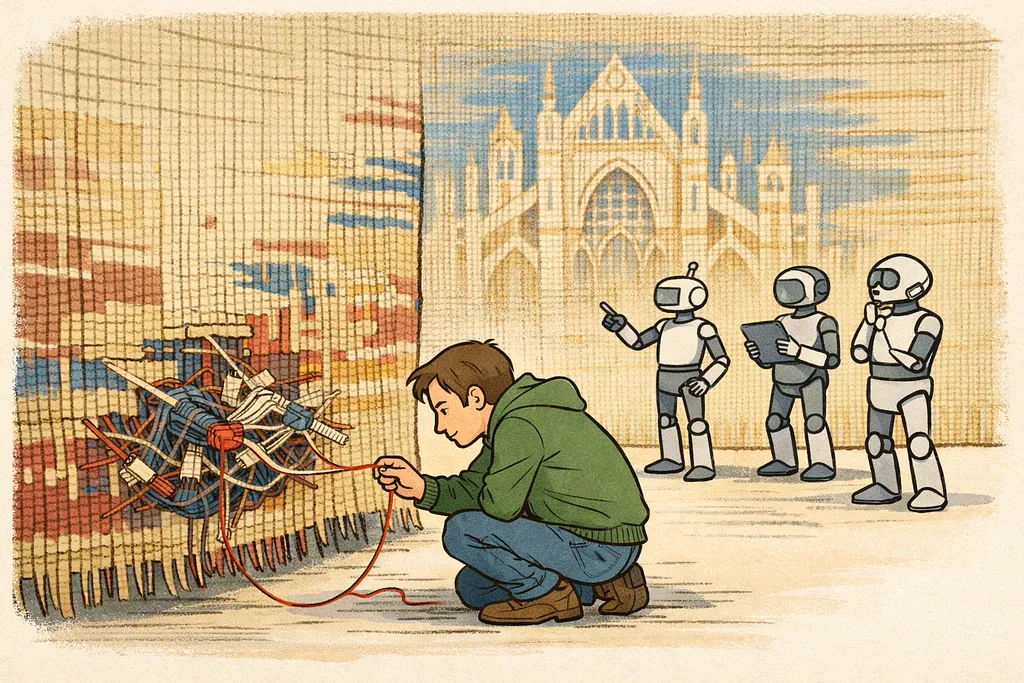
This is what happens when you follow the thread. You ask about one test, and you end up rebuilding the session isolation layer.
Meanwhile, the strategic work
The same day — Friday, February 6 — all eight leadership agents submitted their weekly memos. Ship #029 was coming together. The CXO and CIO collaborated on a new “Cathedral Context” vision document, trying to prevent the kind of strategic blindness that lets duplicate sidebars get built in the first place.
Saturday brought a lighter pace. I was still fighting a cold, so the morning was shorter. The Chief of Staff transitioned to Opus 4.6, Anthropic’s new model with a million-token context window. The Head of Sapient Resources created detailed profiles for Ted and Cindy — our most engaged external collaborators. Ted’s Windows testing alone had generated 14 new GitHub issues.
But Sunday was when something shifted.
The question we’d been avoiding
The website had been sitting there, half-built, for weeks. pipermorgan.ai existed, but we’d never really answered the foundational questions: Who is this for? What are we trying to say? How does the website relate to the actual product?
The CXO and Communications Director spent the day on it. By evening, they’d resolved three framing questions that had been floating unanswered:
Audiences: Journey followers (building-in-public readers), methodology learners (people interested in the patterns), and potential users (PMs who might want Piper).
Site vs. product: pipermorgan.ai is consumer-facing storytelling. app.pipermorgan.ai (eventually) is where the hosted product lives.
Call to action: Try Piper first, Get Involved second, Learn More third.
Then Ted Nadeau’s framework clicked into place. The “Why-Molecule” — a way of articulating what problem you’re solving at the atomic level. Applied to Piper, it surfaced something I’d been circling for months:
PM tools assume work is items in lists. But PM work is actually relationships between concerns at different scales.
That’s the gap. Jira gives you tickets. Asana gives you tasks. Linear gives you issues. They’re all list managers with different paint jobs. None of them model what a PM actually does: hold relationships between a user need and a feature, between a strategic goal and a quarterly milestone, between today’s bug and last month’s architectural decision.
By Sunday evening, we had a complete seven-page site draft. Monday, implementation began — five phases, executed cleanly. By the end of the week, the bones of a real website existed.
Two kinds of work
What strikes me about this stretch is the contrast.
Friday was reactive. One question led to another, each answer revealing a new problem. The discipline was following the thread — not stopping when the first fix worked, not declaring victory until we understood the full shape of what was broken.
Sunday was proactive. We stepped back from the code entirely and asked: what are we building, and who is it for? The discipline was different — not following threads but weaving them together, finding the unifying insight that makes everything else cohere.
Both are necessary. You can’t build a cathedral if you don’t follow the threads that reveal structural problems. But you also can’t build a cathedral if you never step back to ask what shape it should be.