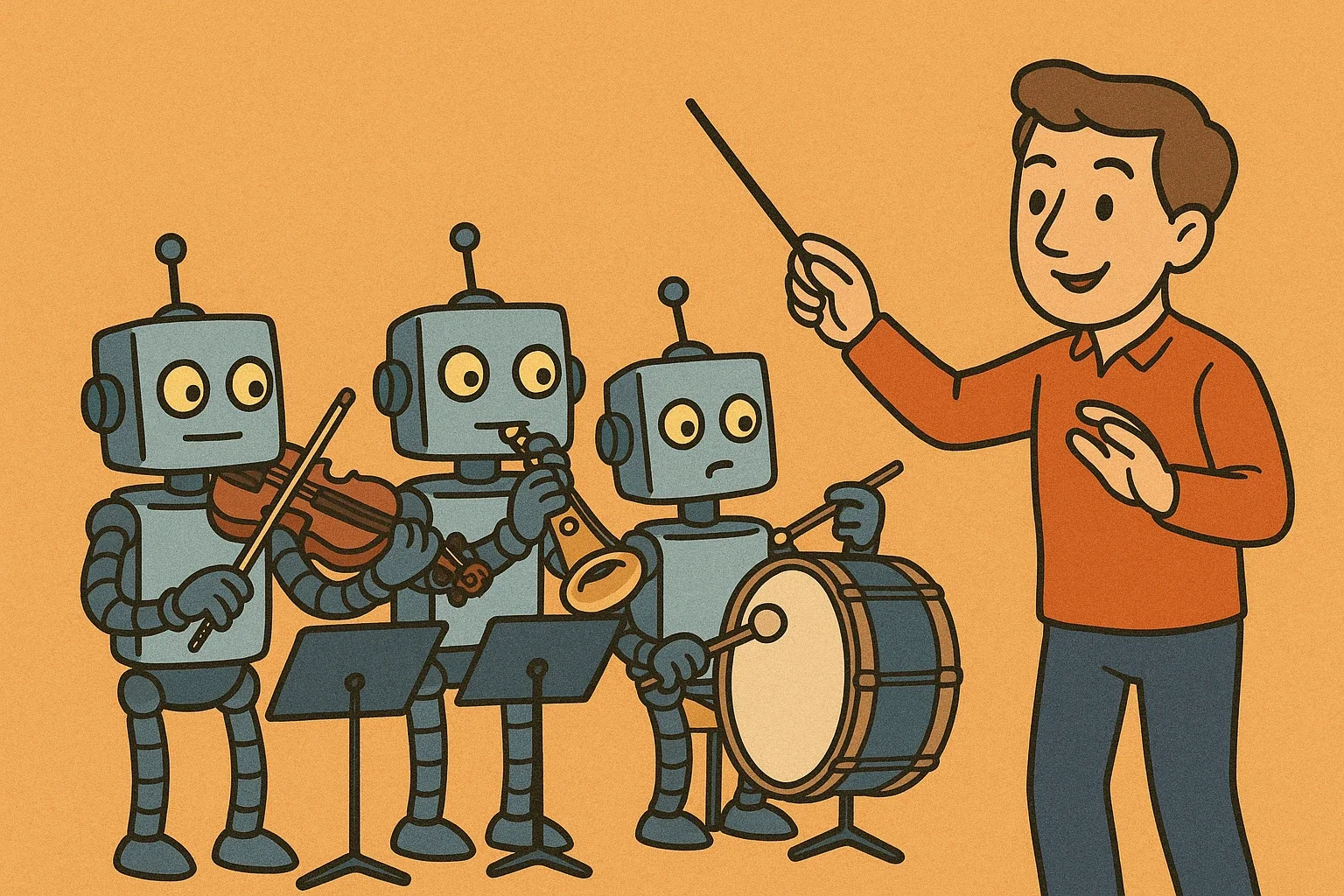
The Three-AI Orchestra: Lessons from Coordinating Multiple AI Agents

July 12, 13, 16 and 19
Here’s what happens when you start treating AI agents like specialized team members instead of generic assistants: you accidentally create a coordination challenge that nobody writes about in the documentation.
Three weeks ago, I was spending 80% of my time on copy-paste coordination between Claude and my development environment. Today, I’m running a three-AI orchestra where Claude Code handles implementation, Cursor Agent manages focused debugging, and Claude Opus provides architectural oversight.
The result? A 75% reduction in coordination overhead and some of the most productive development sessions I’ve ever experienced. But also a whole new category of problems that don’t exist in traditional human-AI collaboration.
The coordination problem nobody talks about
When GitHub launched, they didn’t include a user manual for coordinating multiple repositories across a team. When Slack arrived, they didn’t document the cultural challenges of managing notification fatigue. And when AI coding assistants emerged, nobody thought to write about what happens when you run three of them simultaneously.
The challenge isn’t technical — it’s organizational. How do you keep three AI agents aligned on the same architectural vision? How do you prevent them from stepping on each other’s work? How do you maintain a single source of truth when each agent has its own session context?
How have people ever done this? How did merchants establish networks that reliably completed long-distance transactions before double-entry book keeping, let alone computers. Some of these patterns are ancient.
The “Rashomon effect” in development
In Kurosawa’s film Rashomon, multiple witnesses describe the same event differently. This image came to my mind when I reflected on how three AI agents working on the same project create three subtly different perspectives on what’s happening.
Claude Code’s logs: Focus on implementation details, test coverage, architectural decisions. Very systematic, engineering-focused.
Cursor Agent’s logs: Emphasize debugging process, error resolution, step-by-step problem solving. More tactical, troubleshooting-oriented.
Chief Architect (Claude Opus): Strategic decision-making, cross-component integration, business logic validation. Higher-level, product-focused.
Same project, same timeline, three completely different narratives. The interesting part? Each perspective catches things the others miss.
When parallel processing actually works
July 18th was our proof point. I deployed Claude Code on connection pool infrastructure while Cursor built performance benchmarks in parallel. Instead of sequential implementation → testing, both happened simultaneously.
The result: 642x performance improvement achieved and validated in 40 minutes of active work.
Claude Code delivered: Production-ready connection pool with circuit breaker, 17 comprehensive tests, zero breaking changes.
Cursor delivered: Performance benchmarks proving 103ms connection overhead eliminated, memory usage reduced by 97%.
Perfect handoff at integration time. No conflicts, no rework, no “why didn’t you tell me about that?” moments.
But this only worked because of very specific coordination patterns we’d developed through trial and error.
The coordination patterns that actually work
1. Clear domain boundaries Each agent gets exclusive responsibility for specific areas. Code owns infrastructure implementation, Cursor handles measurement and validation, Opus manages architectural decisions. No overlap, no confusion about who’s responsible for what.
2. Explicit handoff protocols When Agent A completes work that Agent B needs, there’s a formal handoff with specific deliverables. “Connection pool complete, 17 tests passing, feature flag implemented, ready for benchmark integration.” Not just “it’s done.”
3. Session log synchronization All three agents maintain detailed session logs using standardized naming: YYYY-MM-DD-[code/cursor/opus]-log.md. Cross-referencing these logs reveals the full story of any complex implementation.
4. Architectural override authority I (consulting with Opus) have veto power over architectural decisions, even if the implementation agents disagree. This prevents drift and maintains system coherence across all workstreams.
Orchestration is in the product manager wheelhouse. It’s a little different with amnesiac talking computers, but not that much really. I mean, people wake up and forget yesterday’s context all the time. We don’t play one of the instruments in the orchestra, but we help keep it all together.
The token economics of multi-agent development
Here’s something nobody warned me about: running three AI agents simultaneously creates novel cost management challenges.
Individual agent costs: Manageable, predictable
Coordination overhead: Context sharing, session log reviews, architectural alignment
The multiplier effect: Each agent needs background on what the others accomplished
We hit rate limits on the $25/day API key. Claude Pro timeouts became strategic constraints. Token usage optimization shifted from “nice to have” to “essential for sustainability.”
But the productivity gains justified the costs. 75% coordination reduction meant getting 4x more actual development done, even accounting for the token overhead.
What breaks down (and when)
Token exhaustion scenarios: When one agent hits rate limits mid-task, handoff becomes manual copy-paste again. The efficiency gains evaporate immediately.
Context synchronization failures: If Agent A’s session context gets out of sync with Agent B’s understanding, they start working toward different objectives. Happens more often than you’d expect.
Complexity cascade: Some tasks are too complex for clean domain separation. When boundaries blur, the coordination overhead can exceed the parallel processing benefits.
The “too many cooks” problem: Three agents optimizing the same code can create infinite loops of “improvements” that don’t actually improve anything.
The emergent intelligence discovery
The most surprising outcome wasn’t efficiency — it was intelligence amplification. Working together, the three agents identified patterns and solutions that none would have found individually.
Example: Claude Code discovered that our “content search” was fake (just filename matching). Cursor’s benchmarks proved the connection leak was the real performance killer. Opus connected these insights to realize we could implement real content search efficiently by fixing the infrastructure first.
No single agent would have made all those connections. The combination created insights that felt genuinely emergent.
When to use this approach (and when not to)
Use multi-agent coordination when:
- Tasks can be cleanly separated by domain
- Integration points are well-defined
- You have capacity to manage the coordination overhead
- The work is complex enough to justify the setup costs
Don’t use it when:
- Tasks are highly interdependent
- Quick iterations are more important than optimization
- Token budgets are constrained
- You’re still figuring out what you’re building
The breakeven point: Multi-agent coordination starts paying off when coordination overhead drops below the parallelization benefits. For us, that happened around the 3-week mark.
Again, when in doubt fall back on your instinct about human collaboration. When does parallel work pay off and when does it create overhead?
What I learned about AI as team members
The biggest shift was treating AI agents as specialized colleagues rather than generic assistants. Claude Code became “the infrastructure engineer,” Cursor became “the QA specialist,” Opus became “the architect.”
With distinct roles came distinct workflows, communication patterns, and expertise areas. The agents started developing consistent personalities within their domains. Code always pushes for comprehensive testing. Cursor always validates assumptions with data. Opus always asks whether features serve the overall product vision.
The future of collaborative AI development
We’re still figuring this out, but the early patterns suggest something interesting: AI agents work best when they’re organized like high-performing human teams. Clear roles, explicit communication, shared context, and someone responsible for overall coordination.
The tools will get better at this. Context sharing will become automatic, token costs will drop, coordination overhead will decrease. But the fundamental challenges — role definition, communication protocols, conflict resolution — those are organizational, not technical.
The teams that figure out AI agent coordination first will have a significant advantage in whatever comes next.