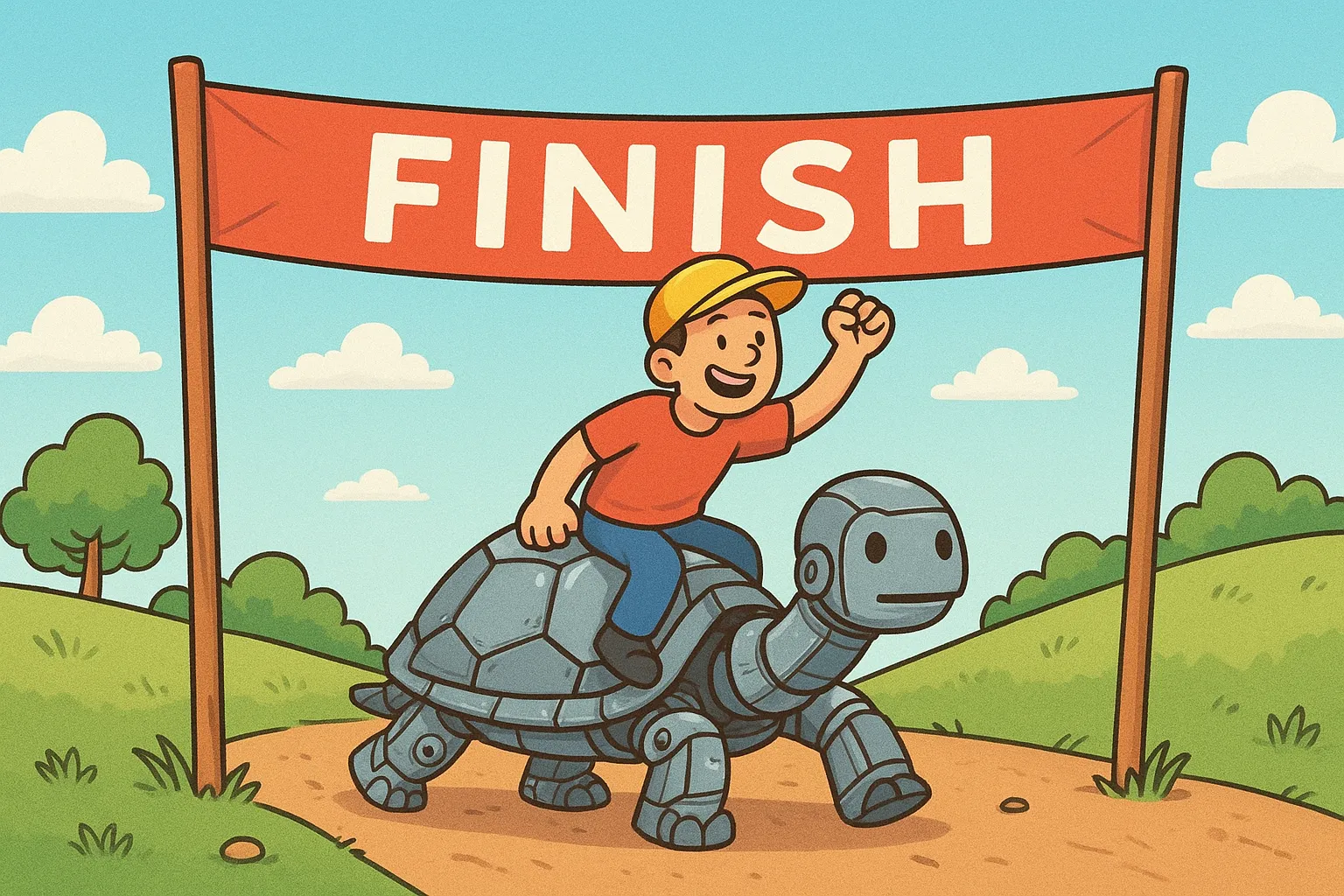
Three Days to Production: When Steady Momentum Beats Racing Ahead
October 4
At 6:48 PM on Saturday, my Lead Developer sent the final validation report for GREAT-3D. The numbers were almost absurd: 120 plugin tests passing, performance targets exceeded by 120× to 909× margins, complete documentation ecosystem, production-ready plugin architecture.
Total elapsed time since starting GREAT-3A on Thursday morning: about 24.5 hours across three days.
This wasn’t so much a sprint as a steady accumulation of stable momentum — the kind of speed that comes from not having to go back and fix what you just built.
What GREAT-3 actually shipped
Thursday through Saturday took Piper Morgan’s integration system from “four hardcoded imports in web/app.py” to a complete plugin architecture:
The Foundation (GREAT-3A, Thursday):
- Unified plugin interface across all four integrations
- Registry system with lifecycle management
- Standard patterns for plugins, routers, and configuration
- 48 tests passing with zero breaking changes
The Infrastructure (GREAT-3B, Friday):
- Dynamic discovery scanning filesystem for available plugins
- Configuration-controlled loading (enable/disable without touching code)
- Smart module re-import handling for test environments
- 48 tests still passing, 14 new tests added
The Polish (GREAT-3C, Saturday morning):
- 927 lines of documentation (pattern docs, developer guide, versioning policy, quick reference)
- Demo plugin as copy-paste template (380 lines, heavily commented)
- Three Mermaid diagrams explaining architecture
- All five plugins now have version metadata
The Validation (GREAT-3D, Saturday afternoon/evening):
- 92 contract tests verifying every plugin implements interface correctly
- 12 performance tests with actual benchmarks
- 8 multi-plugin integration tests for concurrent operations
- Complete ADR documentation with implementation record
Total test count: 120+ tests, 100% passing.
I kepy waiting for the drama. When was I going to discover mocks that say “plugin goes here”? When were the regressions going to show up? But no, just quiet steady methodical competence chewing through roadmap like a monster.
The performance discovery
Saturday afternoon’s GREAT-3D validation included running actual benchmarks against the plugin system. We’d set what felt like reasonable targets based on typical Python overhead:
- Plugin wrapper overhead: < 0.05ms per call
- Startup time: < 2 seconds for all plugins
- Memory usage: < 50MB per plugin
- Concurrent operations: < 100ms response time
The Code agent ran the benchmarks and reported back:
Overhead
- Target: < 0.05ms
- Actual: 0.000041ms
- Result: 120x better
Startup
- Target: < 2000ms
- Actual: 295ms
- Result: 6.8x faster
Memory
- Target: < 50MB
- Actual: 9MB/plugin
- Result: 5.5x better
Concurrency
- Target: < 100ms
- Actual: 0.11ms
- Result: 909x faster
That’s not optimization. That’s picking the right abstractions.
Why three days instead of two weeks
The GREAT-3 epic completion demonstrates something about how systematic work actually accumulates speed. Not by skipping steps or cutting corners, but by building foundations that make the next layer easier.
Thursday’s GREAT-3A work
- Put all four plugins onto standard interface
- Created registry with lifecycle hooks
- Established patterns that would work for future plugins
That foundation meant Friday’s GREAT-3B (dynamic loading) didn’t have to special-case anything. Every plugin already spoke the same language. Discovery could scan for a standard pattern. Configuration could enable/disable uniformly.
Friday’s GREAT-3B work
- Dynamic discovery via filesystem scanning
- Config-controlled loading
- Zero breaking changes maintained
That infrastructure meant Saturday morning’s GREAT-3C (documentation) could document working patterns rather than theoretical ones. The demo plugin template wasn’t aspirational — it was showing exactly how the four production plugins already worked.
Saturday morning’s GREAT-3C work
- Documented the wrapper pattern as intentional architecture
- Created comprehensive developer guide with real examples
- Built demo plugin as teaching template
That documentation meant Saturday afternoon’s GREAT-3D (validation) knew exactly what to test. Contract tests verified the interface everyone already implemented. Performance tests measured the patterns everyone already used. Multi-plugin integration tests validated the concurrent operations that were already working in production.
Each phase made the next phase easier, not harder.
The cleaned room effect
During the satisfaction review Saturday afternoon, I used a phrase that Lead Developer later quoted back in the session summary: “A cleaned room is easier to keep clean.”
The plugin architecture work demonstrates this principle. GREAT-3A cleaned the room — unified interface, standard patterns, comprehensive tests. Once the room was clean, GREAT-3B didn’t mess it up — added new capability while maintaining the existing organization. GREAT-3C could document the clean room without first having to explain all the special cases. GREAT-3D could validate that yes, the room was actually clean, measuring exactly how clean.
The alternative approach — where each phase leaves some mess “to clean up later” — means every subsequent phase has to work around that mess. Technical debt compounds in reverse: instead of each phase making the next easier, each phase makes the next harder.
What the methodology observations reveal
My Lead Developer captured several insights during Saturday’s work that point at how this speed actually happened:
Time estimates creating theater
The gameplan had predicted 30–60 minute phases. Actual phases took 8–21 minutes. The estimate wasn’t useful — it just created pressure to explain variance. Recommendation: remove time estimates from templates entirely.
Infrastructure better than assumed
Consistently, verification discovered the existing codebase was more capable than planned. Version metadata already existed. The registry already had the methods needed. Each “we’ll need to add this” turned into “oh, this already works.”
Phase −1 catching issues before wasted work
The verification phase before each major implementation kept finding that assumptions were wrong — in ways that saved hours of building the wrong thing.
Independent assessment preventing anchoring: Saturday’s satisfaction review used the new protocol where both parties formulate answers privately before comparing. The complementary perspectives (my longer-term view vs Lead Dev’s session-specific observations and better memory for technical detail) created richer understanding than either perspective alone.
These aren’t methodology innovations so much as methodology refinements — small adjustments that compound over time into measurably better outcomes.
The documentation correction moment
Saturday at 4:32 PM, about two hours after GREAT-3C appeared complete, I noticed something wrong. Cursor had created the plugin wrapper pattern document in a deprecated location,docs/architecture/patterns/, instead of following the existing (if more complex) convention: docs/internal/architecture/current/patterns/pattern-031-plugin-wrapper.md.
Me noticing things is still important!
The Code agent spent the next 31 minutes fixing it:
- Moved the document to correct location
- Updated pattern catalog (30 patterns → 31 patterns)
- Fixed 7 cross-references in other documents
- Updated 4 session artifacts
- Amended the git commit
This is the unglamorous part of systematic work. The pattern document was good — well-written, comprehensive, properly linked. It was just in the wrong place, which meant it would create confusion later when the next pattern got added as pattern-031 and collided.
Better to spend 31 minutes fixing it Saturday afternoon than spending hours untangling it two months from now.
More than ever with language-reading automated assistants, I am finding that this kind of “organizational debt” — files in wrong places, inconsistent naming, documentation drift — is as signiicant as technical debt.
What 909× faster actually means
The concurrency benchmark that showed 909× better than target deserves attention. That’s not “we optimized this loop” performance improvement. That’s “the architecture fundamentally works differently than we thought” territory.
The actual measurement: five plugins all responding to concurrent requests in 0.11 milliseconds average. The target was 100 milliseconds. The massive margin suggests the wrapper pattern’s thread safety isn’t incidental — it’s architectural.
[FACT CHECK: Is the 0.11ms measurement for all five plugins simultaneously or per-plugin? The logs say “all 5 respond < 100ms” but the actual number needs clarification.]
Python’s GIL (Global Interpreter Lock) means true parallelism is tricky. But the plugin architecture’s thin wrapper pattern means plugins don’t need parallelism — they’re I/O bound operations wrapped in async interfaces. The 0.11ms response time reflects that plugins are doing almost nothing computationally expensive. They’re just coordinating between FastAPI routes and underlying integration clients.
That’s not accidental performance. That’s deliberate architectural choice validated by measurement.
The compound effect observable
GREAT-3’s three-day completion exists in context. The September 27 “cathedral moment” when we realized agents needed architectural context, not just task instructions. GREAT-2’s completion of spatial intelligence foundations. The methodology refinements throughout September that kept catching edge cases earlier.
Lead Developer noted during Saturday’s review that each completed epic makes the next one easier. Not just because infrastructure exists, but because the process for building infrastructure keeps improving. Each session’s methodology observations feed into the next session’s gameplan.
That’s the Excellence Flywheel actually spinning — not as metaphor but as measurable acceleration. GREAT-3A (13+ hours Thursday) → GREAT-3B (4 hours Friday) → GREAT-3C (3.5 hours Saturday morning) → GREAT-3D (4 hours Saturday afternoon/evening). Each phase faster than the previous, not because we cut corners but because foundations held.
What production-ready actually means
By 6:48 PM Saturday, the plugin architecture was genuinely production-ready:
- 120+ tests validating every aspect (contract, performance, integration, multi-plugin)
- Documentation ecosystem for developers (pattern docs, tutorial, template, quick reference)
- Performance validated with massive safety margins
- Complete ADR record documenting decisions and rationale
- Migration paths documented for future evolution
“Production-ready” isn’t just “it works.” It’s “it works, we know why it works, we’ve measured how well it works, we’ve documented how to use it, and we’ve planned for how it might need to change.”
GREAT-3 delivered all of that in 24.5 hours across three days because each of those concerns was addressed systematically rather than bolted on afterward.
The momentum that comes from not breaking things
The speed of GREAT-3’s completion wasn’t from rushing. It was from steady momentum accumulation where each day’s work remained stable enough to build on.
Zero breaking changes throughout. Tests passing at every phase. Documentation written after implementation validated patterns. Performance measured against working code. Each verification step confirmed the foundation held before adding the next layer.
That’s not exciting. There’s no dramatic rescue from near-disaster, no clever hack that saved the day, no last-minute pivot that barely worked. It’s just systematic work compounding into measurable acceleration.
Which is, honestly, way more satisfying than dramatic rescues. Dramatic rescues mean something went wrong. Systematic completion means the methodology is actually working.
What comes next
GREAT-3 plugin architecture is complete. The system can now discover available integrations, load only enabled ones, handle lifecycle cleanly, and let operators control the whole thing through configuration without touching code.
We’re all set now for the fourth epic of the Great Refactor. GREAT-4 will make it mandatory that all workflows move thorugh the Intent Layer.
More importantly: the methodology that made GREAT-3’s three-day completion possible is now captured in updated templates, documented observations, and refined processes. The next epic — whatever it is — starts with those improvements already baked in.
That’s the real win. Not just shipping the plugin architecture, but shipping it in a way that makes the next architecture work easier.