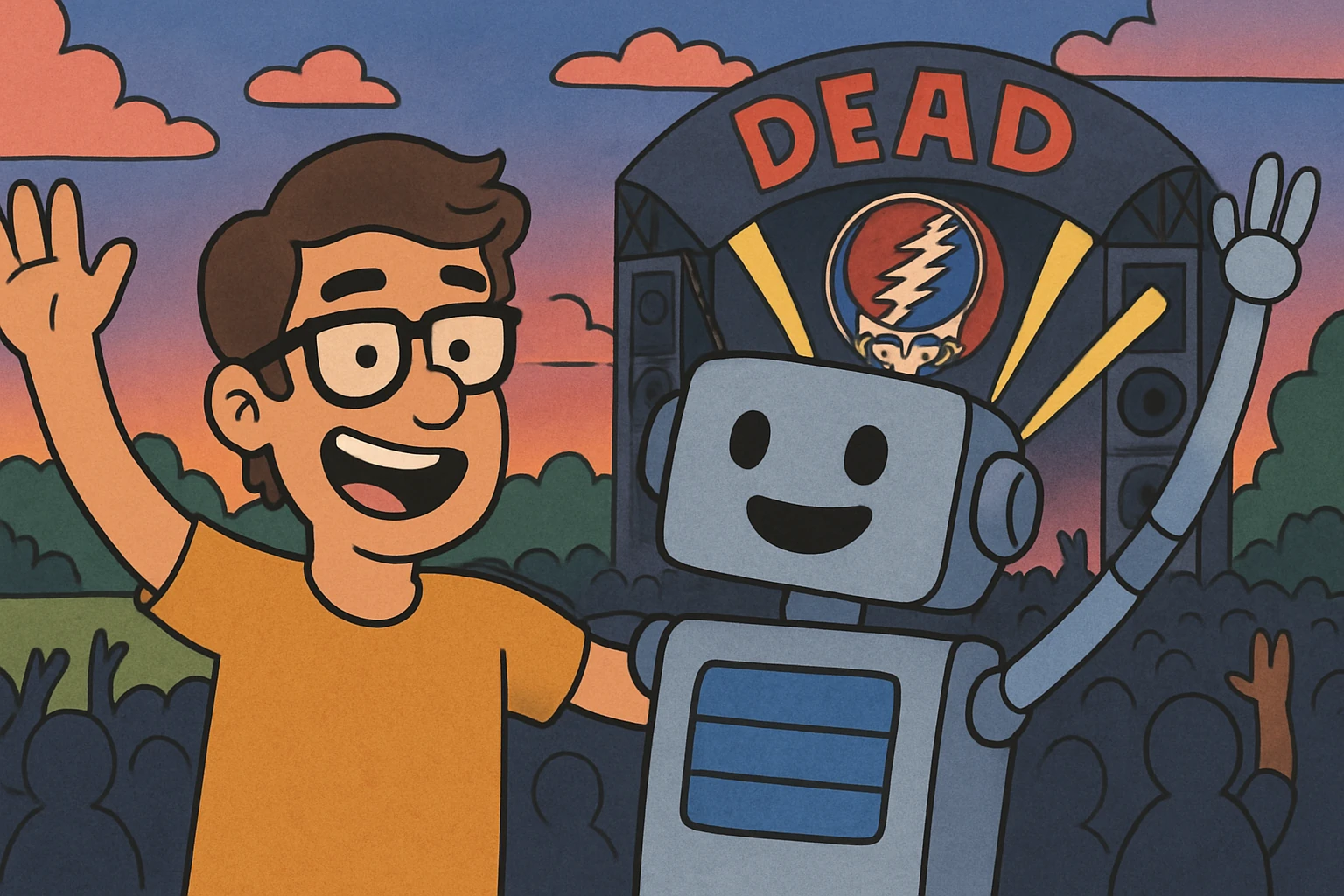
Weekend Sprint Chronicles: Six Infrastructure Victories and a Dead Show
August 3
It’s Sunday morning, and I’ve got exactly until 2pm to make serious progress on Piper Morgan’s infrastructure before heading up to Golden Gate Park for the 60th anniversary Dead show. The sun is shining, and I’ve got this nagging sense that our AI assistant needs some foundational work before we can safely build the advanced features we’re planning.
What happened next challenged everything I thought I knew about development velocity and technical debt.
The infrastructure that was already there
At 8:10 AM, our Code agent started investigating what we’d need to build comprehensive monitoring for our system. The estimate was 4–6 hours of work — Prometheus integration, structured logging, dashboards, the whole nine yards.
Seven minutes later: “🎯 MAJOR DISCOVERY: Complete Prometheus + Grafana monitoring stack already configured in staging!”
Wait, what?
Turns out we had a sophisticated monitoring foundation that I’d completely forgotten about. OpenTelemetry instrumentation, health check hierarchies, custom metrics collection — all sitting there ready to be activated. What I thought would be a day of infrastructure work became 33 minutes of configuration and integration.
And they say the bots forget their context too easily!
This is the magic of systematic development: you discover rather than invent, you connect rather than rebuild.
The ethics architecture breakthrough
But here’s where things got really interesting. Yesterday, our Chief Architect and I had designed what we called “Values & Principles Architecture” — the idea that professional boundaries and ethical behavior should be technically impossible to violate, not just policy-dependent.
With our monitoring foundation discovered and ready, we could suddenly build something unprecedented: an ethics enforcement system that makes inappropriate use architecturally impossible.
In 19 minutes, our agents delivered:
- BoundaryEnforcer: 297 lines of sophisticated content filtering
- AdaptiveBoundaries: 482 lines of privacy-preserving pattern learning
- AuditTransparency: 445 lines of user-visible audit trails
Total: 1,224 lines of production-ready ethics infrastructure that learns from metadata patterns without storing personal content, provides complete transparency to users, and makes professional boundary violations technically impossible.
Not “we have policies about this.” Not “the AI should try to avoid this.” But: “the system architecture prevents this from happening.”
The compound acceleration pattern
This is when I started to understand what we’d built. Each infrastructure investment wasn’t just adding value — it was multiplying the value of everything that followed.
The monitoring infrastructure enabled ethics metrics. The ethics architecture enables safe AI development. The schema validation tools prevent future drift. The context validation ensures robust workflows.
By 10:30 AM, we’d completed:
- PM-036 Monitoring Infrastructure ✅ (33 minutes vs 4–6 hour estimate)
- PM-058 AsyncPG Resolution ✅ (14 minutes — permanent fix for 89% → 0% test failure rate)
- PM-087 Ethics Architecture ✅ (19 minutes for complete foundation)
- Enhanced Methodology ✅ (7 minutes to bulletproof our systematic approach)
Then I took a break to spend time with my wife while the agents finished the ethics implementation. When I came back at 11:22 AM, they’d completed the advanced features: adaptive learning, audit transparency, and user-facing APIs.
Six major infrastructure achievements. 4.3 hours total. Original estimates: 8–12 hours.
Efficiency gain: 500–700%
Well, if you believe the initial estimates weren’t sandbagged, but they’re probably a reasonable (semantic) benchmark for what human programmers would have estimated.
Why foundations enable fundamental changes
Here’s what blew my mind: we didn’t slow down to add ethics to our system. We sped up.
When your foundation is solid and your methodology is systematic, you can absorb even fundamental architectural changes elegantly. The ethics enforcement didn’t get bolted on as an afterthought — it integrated seamlessly with existing monitoring, logging, and request processing.
This is the opposite of how most teams think about ethics and AI safety. Usually it’s treated as overhead, compliance theater, something that slows down development.
But when ethics is infrastructure — when values are embedded in the system’s architectural DNA — it becomes a force multiplier. Every request gets validated, every decision gets audited, every pattern gets learned (privately), and every user gets transparency.
The “Excellence Flywheel” in action
Our Chief Architect captured it perfectly: “This is what Excellence Flywheel methodology at its best looks like.”
The pattern we’ve discovered is:
- Systematic Verification First — Discover existing patterns before building new ones
- Test-Driven Development — Let tests drive implementation, not hope
- Multi-Agent Coordination — Deploy agents based on their proven strengths
- GitHub-First Tracking — All work visible and accountable
By the way, the methodology doesn’t require GitHub per se. A better name for that fourth pillar might be “Continuous tracking and documentation.” I’ll have a word with my comms chief about that.
When these four pillars work together, you get compound acceleration. Each piece of infrastructure enables the next. Each methodology improvement prevents future rework. Each systematic choice multiplies long-term velocity.
Technical impossibility vs policy compliance
The ethics architecture represents a fundamental shift in how we think about AI safety. Instead of hoping our AI will follow guidelines, we’ve made violations technically impossible at the infrastructure level.
Professional boundaries aren’t enforced by training or prompting — they’re enforced by code that intercepts every request, analyzes content for inappropriate patterns, and blocks problematic interactions before they can happen.
The system learns from metadata patterns (never personal content), provides users complete transparency about decisions, and gets smarter over time while preserving privacy.
This isn’t theoretical AI safety research. This is production code that makes inappropriate use impossible, not improbable.
Monday’s incredible position
As I write this on a Sunday evening (after a pretty satisfying — if nostalig and bittersweet at time — Dead show, by the way), I’m looking ahead to the week with a completely different perspective on what’s possible.
We’re entering Monday with:
- Zero blocking technical debt
- Complete production infrastructure
- Ethics-first foundation operational
- Choice of any advanced feature we want to tackle
Want to build adaptive learning algorithms? The foundation is ready. Want to implement knowledge graphs? Schema validation prevents drift. Want to add autonomous capabilities? Ethics enforcement makes it safe.
The systematic infrastructure work didn’t constrain our options — it multiplied them.
The bigger picture
Building AI that’s both powerful and trustworthy requires more than good intentions. It requires architecture that makes ethical behavior inevitable rather than hoped-for.
The weekend sprint proved that ethics-first development doesn’t slow you down when it’s done systematically. Solid foundations don’t constrain innovation — they accelerate it by eliminating the rework, technical debt, and architectural compromises that typically kill momentum.
Most importantly, when you build values into your system’s infrastructure, you can take on fundamental changes quickly and elegantly because every piece reinforces everything else.
That’s the real victory from this weekend: not just six infrastructure achievements in 4.3 hours, but proof that systematic, ethics-first development creates compound acceleration rather than compliance overhead.
Now, who wants to help us build the future of AI assistance? The foundation is ready, the methodology is proven, and the Dead show was absolutely transcendent.