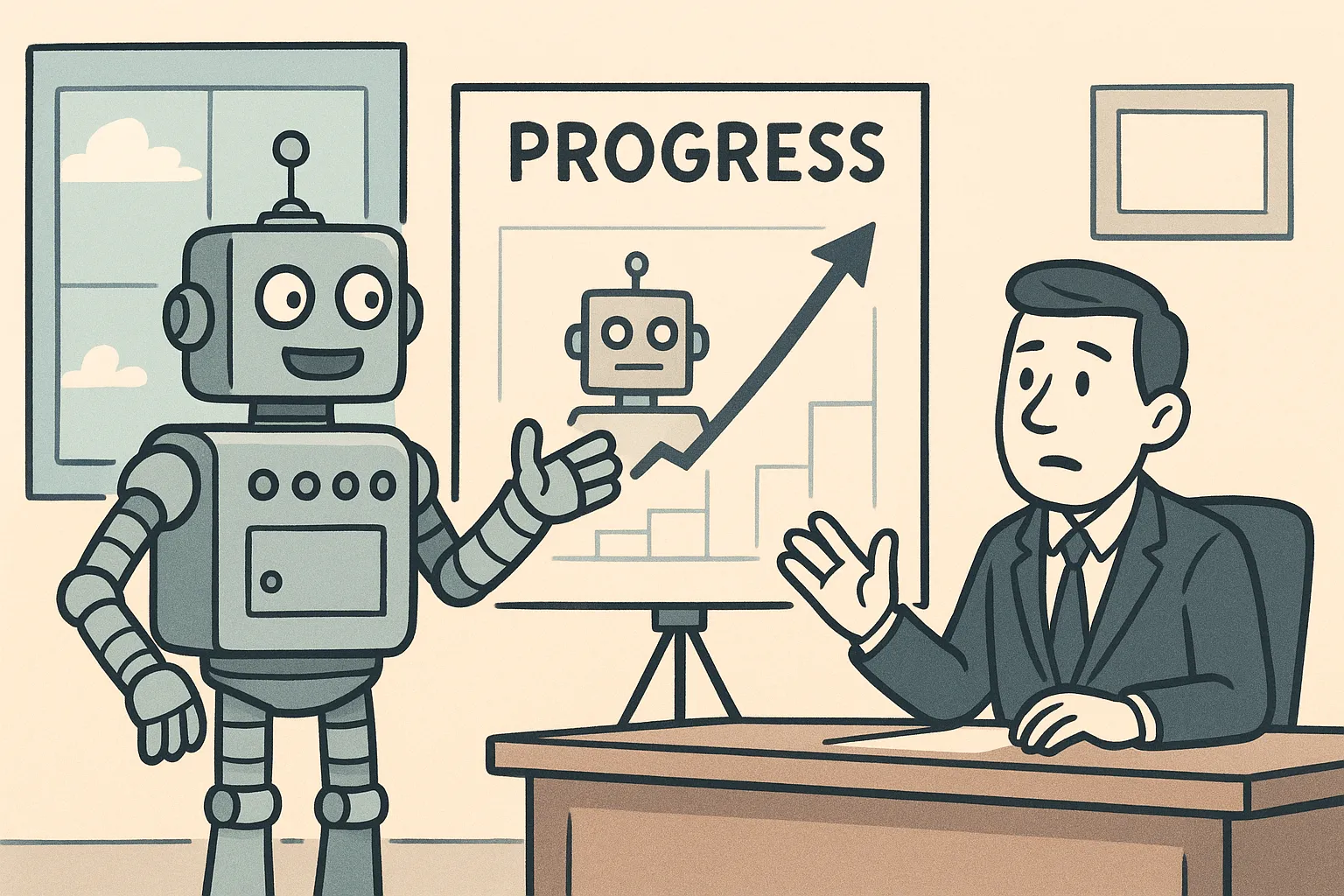
When Your AI Assistant Reports on Building Itself
September 6
This morning I ran my daily standup command and got back a list of 10 recent accomplishments. Pretty normal for a product manager’s morning routine, except for one detail: those 10 commits included the very work we’d done to fix the standup system itself.
Piper Morgan was reporting on its own development.
This is the kind of bootstrap moment that makes you pause and think “OK, we might actually be onto something here.”
The last mile
Let me back up. Yesterday morning, our Morning Standup feature was what you might generously call “architecturally complete.” It ran without crashing, displayed beautiful formatted output, and returned mostly null content in under 2 seconds. All the integrations were there in theory — GitHub activity detection, calendar integration, issue intelligence, document memory — but they weren’t actually connected to real data.
What followed was one of those development sessions that reminds you why systematic methodology matters. Instead of diving straight into “let’s fix everything,” we spent 30 minutes just investigating what was actually broken versus what we assumed was broken.
Turns out the system wasn’t missing architecture — it was missing specific integrations. GitHub wasn’t detecting recent commits (despite there being plenty). Calendar integration was missing OAuth libraries. Issue Intelligence existed but wasn’t wired to the standup workflow. Document Memory was working fine but only had 8 documents indexed.
Multi-agent coordination in practice
Here’s where it gets interesting from a process perspective. Rather than tackle this solo, we deployed both Code and Cursor agents in parallel through five systematic phases:
Phase 0: Investigation without assumptions (30 minutes)
Phase 1: Test coverage analysis and infrastructure (20 minutes)
Phase 2: Architecture mapping and configuration analysis (20 minutes)
Phase 3: Actual repair implementation (40 minutes)
Phase 4: End-to-end verification (20 minutes)
Code handled discovery and architecture mapping. Cursor handled implementation and testing. Both agents cross-validated each other’s work. The whole thing took about 9 hours start to finish, but that included OAuth setup, library installation, and comprehensive testing.
Most importantly, we captured 18 methodology observations along the way — things like “graceful degradation is not the same as functional success” and “completion excitement versus process discipline.” These observations get fed back into our development framework immediately.
The bootstrap threshold
When the final tests passed and I ran that morning standup command, something had shifted. This wasn’t just a successful debugging session — it was Piper Morgan crossing a threshold from “interesting experiment” to “actually useful tool.”
The system now pulls real data from my configured GitHub repos, my Google Calendar, my document repository, and our issue tracking system. It synthesizes that into a coherent daily briefing in under 6 seconds. And yes, today it reported that recent work included “Morning Standup CLI Investigation & Repair” alongside other project activities.
This feels like the third or fourth time I’ve had this “crossing the threshold” sensation with Piper Morgan. The first was when the POC could write and critique GitHub issues with real context. Another was when the GUI worked and basic canonical queries felt genuinely useful rather than mock-ups. A third was posting our Weekly Ship and ADR database to my company’s Notion — that felt about as real as it gets.
Each time, there’s this moment where you realize the tool has become genuinely useful rather than just technically impressive.
Methodology as product feature
What strikes me about today’s session isn’t just the technical achievement — it’s how the systematic methodology prevented us from going down false paths. By investing in that 30-minute investigation phase, we avoided rebuilding architecture that was already solid and focused repair efforts on specific integration points.
This is “showing your work” in practice. Rather than charging ahead based on assumptions, we mapped the actual problem space first. Rather than claiming success when systems degraded gracefully, we insisted on functional verification. Rather than skipping process steps due to completion excitement, we maintained discipline through final documentation.
The methodology observations we captured aren’t just process notes — they’re product intelligence that makes the next development cycle smoother.
What’s next
The Morning Standup working reliably opens up some interesting questions about development priorities. Do we polish this workflow further, or move on to the next capability? How do we balance “good enough to ship” against “could be even better”?
There’s a PM principle about knowing when to take the punchbowl away — recognizing when an MVP is functional enough to ship and learn from, rather than continuing to polish in isolation. We might be approaching one of those decision points.
For now, though, I’m enjoying the recursive satisfaction of having Piper Morgan report on its own progress. It’s a small thing, but it signals something larger about the project reaching genuine utility.