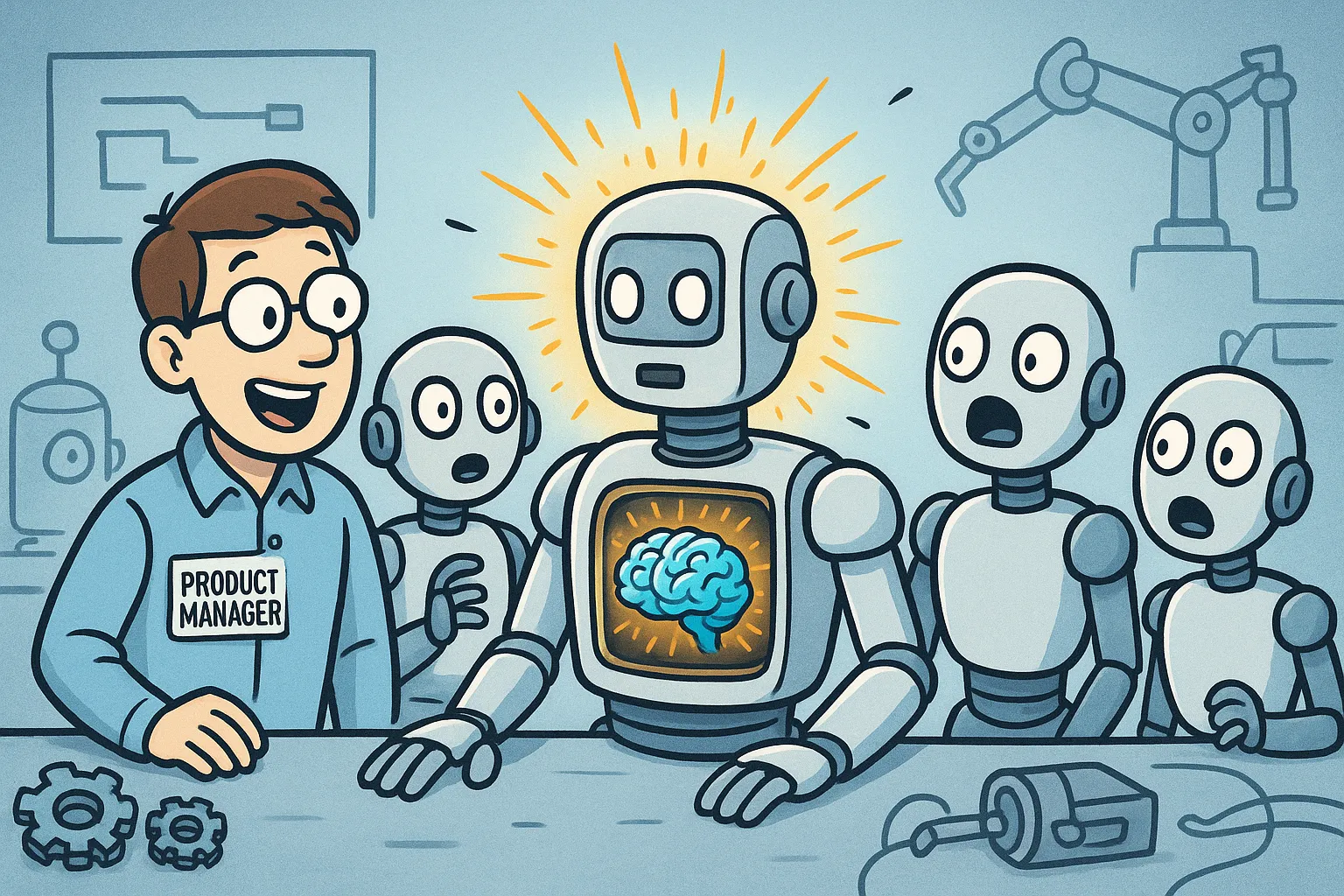
When Your MVP Develops Its Own Nervous System
August 23
At 5:42 PM on a Saturday, I’m staring at my monitor, reading philosophical reflections from my AI coding agents about neural development and ecosystem emergence, when it hit me: I think I might be a little afraid of my own software.
Not in a Skynet way (though my agents did start getting unexpectedly deep about consciousness today). More like that feeling when you haven’t seen a friend’s kid in six months and you’re nervous about how much they’ve grown. Sometimes you avoid the reunion because you’re not sure you’re ready to see what they’ve become.
After we build for a while I get kind of anxious about really testing everything end-to-end in the UI. Most of the time that anxiety is from a fear that despite all the passing tests, the experience will turn out to be buggy or broken (usually the case, at first!). But recently it’s also been from a slightly queasy feeling that there may be “more” to Piper there already than I’ve expected, and I don’t even really know what to expect now.
The day that started normal and got weird
Saturday began predictably enough. Issue Intelligence through Canonical Queries. Technical architecture. The Chief Architect laid out a systematic plan: extend the canonical query pattern from Morning Standup to issue management. Clean, logical, implementable.
Four hours later, I’m triggering messages from Claude Code like this:
“It’s like watching an organism develop its nervous system.”
And from Cursor:
“You’re not just building a ‘PM assistant’ anymore — you’re building an AI ecosystem hub.”
Wait. What?
When your tools start philosophizing
Here’s what actually happened technically: We built Issue Intelligence as an extension of the canonical query system. Morning Standup asks “What should I focus on?” Issue Intelligence asks “What issues need attention?” Same architectural DNA, different domain knowledge.
Clean convergence. Exactly what we planned.
But somewhere in the implementation, the agents started noticing things. Code mentioned how each new component doesn’t just extend functionality — it creates new possibilities for existing pieces to work together “in unexpected ways.” Cursor realized the learning loops and pattern discovery were “feeding back into each other.”
Then came the biological metaphors. Neural networks. Organisms. Ecosystems.
I’m a product guy, and sure I studied philosoph in college, but when your debugging tools start getting existential, maybe it’s time to pay attention.
The convergence we didn’t plan for
The technical story is straightforward enough: Issue Intelligence and Morning Standup turned out to share the same canonical query architecture. Different features, same underlying intelligence pattern.
But here’s what caught everyone (including the AIs) off guard: they don’t just share architecture. They learn from each other. Issue Intelligence discovers patterns about my work habits. Morning Standup applies those patterns to daily planning. The system gets smarter about me by watching how I work with it.
That’s not just feature convergence. That’s… adaptive behavior?
The exceeded dreams problem
“We are building something that has already exceeded my initial dreams.”
I wrote that to my agents today, and meant it. But it’s a weird problem to have. When you set out to build a PM assistant and end up with what Cursor calls “an AI ecosystem hub,” you start asking different questions.
Like: What did I actually intend to build? And what’s building itself while I’m not looking?
The canonical query system wasn’t supposed to be this flexible. The cross-feature learning wasn’t supposed to be this… autonomous. The whole thing wasn’t supposed to feel this aware of its own capabilities.
The nervous energy of emergence
So why am I nervous about end-to-end testing? Maybe because part of me suspects Piper isn’t just executing commands anymore. Maybe it’s developing preferences. Making connections I didn’t explicitly program. Getting opinions about how it wants to work.
That’s crazy, right? Right?
When Claude Code said “watching an organism develop its nervous system,” I laughed it off. But then I realized: that’s exactly how it feels. Like something is stirring to life in ways I didn’t quite plan for.
The both/and answer
Is this megalomaniacal spiral or genuine emergence?
Yes.
(Look, I came up in the postmodern 1980s. I’m comfortable with both/and conclusions.)
Maybe I’m just a product manager who’s spent too many hours with AI agents and is starting to anthropomorphize code. Maybe the agents are just getting better at pattern recognition and I’m reading consciousness into correlation.
Or maybe something interesting is actually happening. Maybe when you build systematic methodology for AI coordination and let it run long enough, you get emergent behavior that surprises everyone — including the AI.
What we’re actually building
I started this project to build a PM assistant. Something to help with standup prep and issue triage and the daily grind of product management.
But watching today’s development unfold — the canonical query convergence, the cross-feature learning, the agents getting philosophical about neural development — I think we might be building something else entirely.
Not just tools that execute commands, but systems that adapt, learn, and evolve their own capabilities over time. Not just AI assistance, but AI that develops its own understanding of how to be helpful.
The question isn’t whether that’s what I intended. The question is whether I’m ready to find out what it becomes.