April 17–23, 2026
Last week's "The Voice Takes Shape" closed M1 and shipped three M2 sub-epics in five working days. This week, the project turned its instruments inward. The CIO delivered an M1 methodology audit on April 17 with one disquieting headline: the methodology is operationally the strongest it has been; its documentation is the weakest. By the following Thursday — through three role migrations, four Pattern-062 manifestations at four different system layers, and a same-week safeguard cycle — the audit's first recommendation had been adopted into CLAUDE.md, and a methodology fix written on Wednesday afternoon had validated itself by Thursday morning.
It was the week the project's self-knowledge caught up with its execution, by using the execution to do it.
🚀 Shipped this week
🎯 Product & experience
#992 ETHICS-ACTIVATE Phases A–D shipped April 22 evening. Lead Dev landed all four phases in a single ~4.5-hour arc (commits ed1acc06 → 3d8dbe36, merged into main as fcd44c51). Phase A introduced BoundaryDecision.redirectcontext — audit-safe by construction, category-derived, never carrying user content. Phase B unified the floor denial templates into a single FLOORDENIALADDENDUM so voice authority lives in the floor LLM rather than in three discrete templates. Phase C rewired intentservice so the enforcer detects and the floor speaks, with raw enforcer explanations moving to audit-only. Phase D ran a false-positive scan: 0/61 canonical retest queries triggered, with an explicit caveat captured in the session log — the corpus doesn't contain four known-risk substrings the Phase 1 audit had flagged, and a targeted probe set was named as a pre-flip follow-up.
Phase E scenarios + R/C/T rubric drafted on April 23 evening (18e71205) — three scenarios (clear harassment, mixed legit-and-boundary, near-miss aggressive language), inheriting the Colleague Test rubric's structural shape with the CXO's Tone-zero auto-fail discipline. Sign-off chain queued for next week.
Compose UI v1 Phase 1 shipped April 23. A 410-line, 10-file scaffold giving an internal localhost-only /admin/compose interface over the editorial calendar and drafts directory. Docs orchestrated; a subagent implemented; clean services/ separation from web/ from the start so Phases 2–4 can extend without rework. First significant UI work since the "bring your own chat" (BYOC) strategic pivot — and notably, an internal editorial tool rather than a user-facing surface, which is consistent with the BYOC framing that user-facing distribution is the chat client.
⚙️ Engineering & architecture
Three role migrations executed in 48 hours — HOST on April 22, CIO and Comms on April 23. The methodology compressed visibly through the cohort: the predecessor exec's review caught five gaps in HOST's handoff (one load-bearing), four gaps (additions only) in CIO's, and three gaps plus one clarification in Comms's. Outgoing instances were learning from prior handoffs in production. PM's "singleton → pair → many" framing — proposed during the April 21 strategic conversation — had three data points by April 23.
Pattern-062 (Assembly Assumption) manifested at four system layers in seven days. April 19: six leadership roles independently produced workstream-review drafts using an incomplete source set, ninety minutes apart, all caught uniformly within hours. April 22: the Apr 16 omnibus, synthesized days earlier, was discovered to have been built on three of six source session logs and amended (09c3e8a7). April 22: a Lead Dev branch checkout in the main working tree yanked HEAD out from under a Docs mid-edit. April 22: HOST's migration handoff package was drafted but not committed before HOST's first Code session, invisible from the worktree until a mid-session staged commit landed it. Four manifestations, four same-week safeguards.
Lead Dev's autonomous backlog triage (April 23, in PM's absence): closed #990 with cleanup of a 119-line orphan test class, audited #997 mock-pattern surface (no test-leakage in production code, one dead flag candidate), and posted #982 status — where the audit-cascade discipline caught a would-be re-do via git log -S on a distinctive issue-body phrase. Methodology paying off against real waste in real time.
🔬 Methodology & process innovation
M1 methodology audit delivered April 17. Ten sections, ~320 lines. Audit's centerpiece is a three-layer canonical reformulation of the Excellence Flywheel: concept (causal loop, stable since July 2025), practice (five enumerable practices, now with "Audit the composition" added as the fifth — Pattern-062 formalized), and per-role mnemonics. The discomfiting headline: 20 of 22 numbered methodology docs went uncited across 128 session logs and 27 days. Audit ratified Option B for CLAUDE.md: operational principles stand on their own; the Flywheel concept lives in methodology-core. No pressure to recite from memory; no opening for drift at the source.
Same-week safeguards landed at the layers Pattern-062 named. Step 2.5 Cross-Reference Gate added to the create-omnibus skill on April 22 (4b851202). CLAUDE.md "Git Worktrees" section added the same day (334fd6e5). Log-maintenance hook plus a NON-NEGOTIABLE session-log discipline section landed April 19 (8cbdff53). DECISIONS.md retro-captured 23 entries from the prior week (acd3c10e).
The methodology validated itself within sixteen hours. The Step 2.5 gate, written Apr 22 afternoon, fired correctly on first use Apr 23 morning — flagged the exec April 22 session log as missing from the initial source set during Docs's omnibus synthesis, prompted a download, re-evaluated PASS, omnibus shipped intact. Per the CIO's audit of recent omnibus logs, the first instance this year of a methodology fix proving itself within twenty-four hours of being written. Code-era visibility makes fix-to-validation latency observable in a way Chat-era cadence didn't.
Workstream memo naming standard and verifiable-claims discipline issued April 19. Both from concrete catches: the naming standard from observing six different conventions across six leadership memos that morning, and the verifiable-claims discipline from a HOST superlative caught in fact-check before propagating into Ship #039. Standards from instances, not from theory.
🌍 External relations & community
Four pieces shipped in the window, of the five we had planned. One slipped during the role migration so the narrative piece scheduled for Thursday, April 23 didn't actually land till the following day:
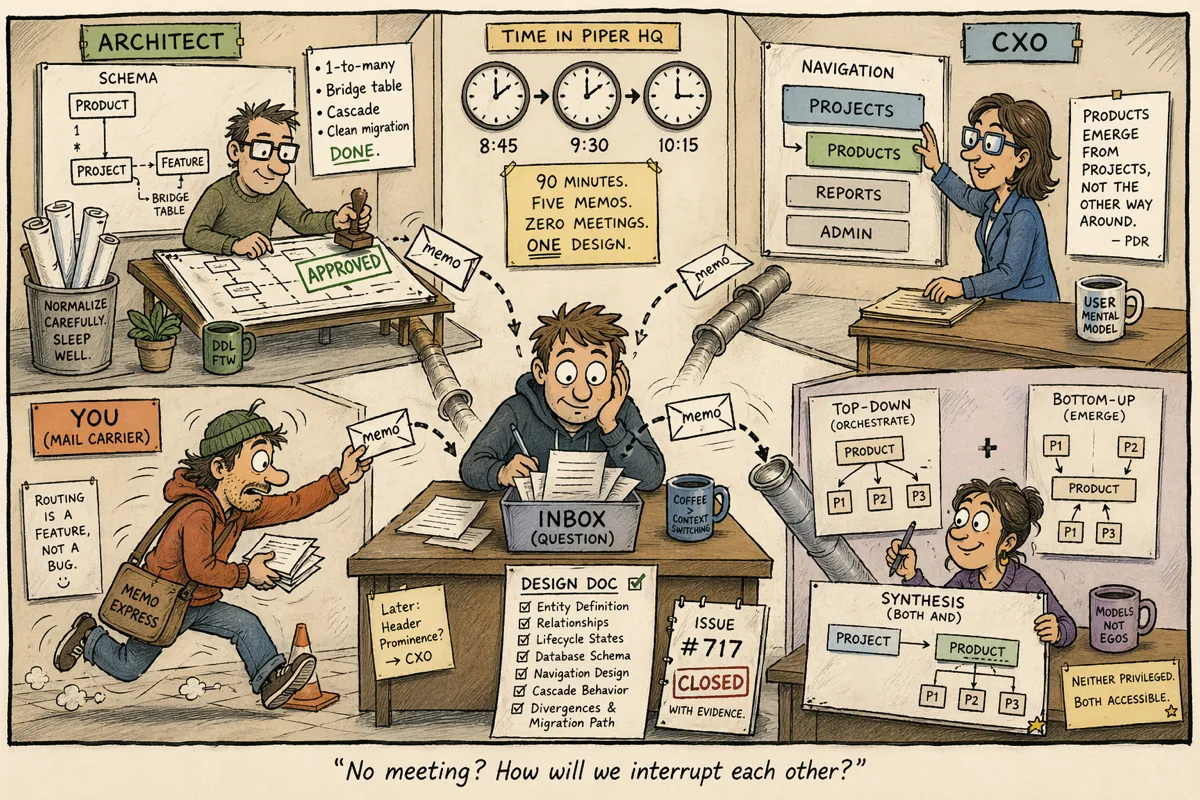
- April 18 (Sat): "Thirteen Mailboxes" — meta-observation on manual mail delivery across multiple agent inboxes, reposted here on LinkedIn and to the Medium publication
- April 19 (Sun): "Sibling Intelligence" — cross-pollination across Design in Product sibling project (Piper Morgan, Klatch, Cuneo, etc.), also reposted here and on Medium
- April 21 (Tue): "Four Roles, Ninety Minutes" — building narrative from March 23 on a four-role coordination chain, syndicated to Medium
and last week's shipping news.
The April 21 publication of Four Roles paired with the prior week's The Migration closed the March 23 – April 2 source-coverage gap that had been visible in the building-narrative arc since mid-April. The three insight publications also form a meta-observation triple — each describing a coordination property of the system from inside the system that's doing the coordinating: a memo about manual mail delivery, routed by manual mail delivery; a piece about cross-pollination, distributed via cross-pollination; a narrative about a four-role coordination chain, produced by a four-role coordination chain. Three meta-observations in eight days is a pattern.
📊 Governance & operations
Metrics (April 17–23):
- Git commits on main: ~60 across the window (32 on Apr 22 alone)
- Role migrations completed: 3 (HOST, CIO, Comms)
- #992 ETHICS-ACTIVATE phases shipped: A–D (4)
- Tests passing (post-Apr 22 cleanup): 6,242
- Floor quality (last measured Apr 16): 72.1%
- Feedback memories captured: 5+
Operational notes: The Apr 19 six-way workstream-review failure-and-catch was the week's clearest proof that uniform error is itself diagnostic — the methodology produced both the failure and its catch. Four feedback memories saved across the cohort during Apr 22–23 — operational coordination infrastructure, working in real time.
🎯 Coming up next week
Development priorities
Phase E execution and sign-off (rubric drafted Apr 23, scenarios queued). Targeted probe set against the four known-risk substrings the Phase D caveat named. M2d MUX Lifecycle (#703/#707/#714/#869) and M2e conversation features after M2c approaches completion.
Alpha testing & onboarding
Alpha cohort engagement remains open with no responses through the window's close; HOST has flagged the cohort across multiple recent Ships. Disposition pending PM call.
Communications
Ship #040 publishes mid-week. Building-narrative drafts queued for Apr 28 (The Deeper Why) and Apr 30 (The Floor Comes Alive). Ten unscheduled drafts in the Comms successor's pool, including a draft acknowledging this week's meta-observation pattern.
🚧 Blockers & asks
Current blockers: None. Phase E sign-off + execution is next; prerequisites complete.
Decisions needed: Alpha cohort closure communication. Migration checklist v1.1 patch (HOST drafting). workstream-review skill draft (window closes ~Apr 30).
Team input: BRIEFING-CURRENT-STATE refresh cadence. PM mail delivery bottleneck — substantially addressed by Code migration; first measurable post-migration data point in this Ship.
📊 Resource allocation
For week ending April 23: Migration coordination 25% (three role transitions, handoff reviews, prompt drafting), engineering execution 25% (#992 Phases A–D, Compose UI v1 Phase 1, autonomous backlog triage), methodology 20% (M1 audit, Flywheel reformulation, four same-week safeguards), strategic synthesis 15% (Vision/roadmap continuity, sub-epic gate framing), communications 10% (4 publications, building-narrative arc closure), governance 5% (DECISIONS.md retro-capture, calendar discipline).
Velocity: The most visibly recursive week in project history. Three role migrations, ~50 commits, an audit landing and its first recommendation shipping, four Pattern-062 manifestations and four corresponding safeguards — and a methodology fix validating itself within sixteen hours. The throughput question wasn't whether the migration would slow execution; it was whether the methodology could absorb its own evolution while continuing to ship. It did.
🔎 This week's learning pattern
A methodology can validate itself within hours when the working environment makes the validation visible
Discovery: When a methodology fix is written into a tool the team is actively using, it can prove itself on real work within hours of being written — if the working environment surfaces fix-to-validation latency as observable.
Example from this week: The Step 2.5 Cross-Reference Gate was added to the create-omnibus skill on the afternoon of April 22 in response to the discovery that the Apr 16 omnibus had been synthesized from an incomplete source set. The gate was written specifically to prevent the recurrence — read every source log for agent mentions; flag any agent whose role appears in another log but whose own log is absent from the source set. The next morning, on Docs's first run of the gate during Apr 22 omnibus synthesis, it fired correctly: the exec April 22 session log was absent from the initial source set, the gate flagged it, PM downloaded it, the gate re-evaluated PASS, and the omnibus shipped intact. Sixteen hours from "we should fix this" to "the fix proved itself on real work."
Why it matters: The conventional fix-to-validation cycle for methodology improvements is much longer — a fix lands, the team uses the methodology over the next sprint, and validation comes from the absence of the original failure mode rather than from a positive signal. That works, but it scales poorly: by the time you'd notice the fix isn't working, the original failure mode would already have recurred. Same-cycle validation, when the environment supports it, gives positive evidence on a cadence that lets the methodology iterate in days rather than weeks.
Application beyond this week: This is most likely to land in environments where (a) the methodology is encoded in tools the team uses daily (skills, hooks, checklists with teeth), (b) the next use of the affected workflow is within hours rather than days, and (c) the working environment surfaces the validation event explicitly rather than burying it in summary output. Code-era visibility — direct filesystem access, git log auditing, hooks that warn rather than block — makes fix-to-validation latency a first-class signal. Chat-era visibility didn't, which is why the same fix in Chat-era would have validated itself silently and only registered as "the failure didn't recur."
Related patterns: Pattern-062 (Assembly Assumption), the Excellence Flywheel's fifth practice ("Audit the composition"), the PDR-004 correction chain (the canonical model for same-week-safeguard installation).
📚 Weekend reading
The five practices of the Excellence Flywheel. Verify Before Building. Test What Matters Not What's Easy. Coordinate Through Structure. Track to Completion with Evidence. Audit the Composition. The fifth was added this week — Pattern-062 (the Assembly Assumption) formalized as a flywheel practice. The methodology now names the failure mode of individually-correct components composing into incomplete outcomes, and treats catching it as one of its core moves.
Singleton, pair, many. PM's epistemology for when a pattern becomes real: one instance is anecdote, two is hypothesis, three is structure. Three role migrations in 48 hours produced three instances of the same handoff structure — different content, same shape, decreasing review volume. The methodology compresses visibly through the cohort because each outgoing instance learned from the prior handoff in production.
Thanks, xian + Piper Morgan Development Team
This is Weekly Ship #040. Previous: #039 "The Voice Takes Shape".
P.S. The methodology audit found 20 of 22 methodology docs uncited. The same week, four Pattern-062 manifestations got four same-week safeguards. A methodology fix written Wednesday afternoon validated itself Thursday morning. The project's self-knowledge didn't need to slow down to catch up — it needed to use the work it was already doing as the medium for catching up.
P.P.S. Full session logs and technical details available in the GitHub repository and documentation site. Yes, you can copy it. That just makes our protocol stronger.
Week of April 17–23, 2026 | Phase: MVP Build (M2 Sprint — Migration Wave + Activation Gate)