July 10–16, 2026
Last week's Ship ended on "impossible by construction" — three decisions built so the wrong behavior couldn't be expressed in code. This week pushed the same idea up a level: instead of fixing one instance so it can't recur, the team built the rule so a whole class of future instances can't recur either. A session-continuity gap open since the alpha launch went from "here's the fix" to "here's the contract every future feature has to pass." A calendar-editing bug that corrupted a shared file became a tool that refuses to let the same mistake happen again, to anyone.
Not everything got the mechanism treatment yet. Three sessions spent the back half of the window unknowingly sharing one working directory — a gap in how work gets provisioned, caught by chance rather than by design, still open as the window closed. Building the thing that makes an error impossible is real progress, and it doesn't happen everywhere at once.
🚀 Shipped this week
🎯 Product & experience
The beta gate kept finding real problems before testers could. All 11 batch-1 alpha invitations went out this window — the "sapient team" now includes external humans for the first time, with welfare monitoring live. The beta-close gate's test scenarios kept earning their keep: a same-day bug pair (an apostrophe rendering wrong, a title cut off mid-parse) got caught and fixed within the hour, and a real gap — the app couldn't yet resolve "actually, change the title" without being told which issue — got named honestly instead of shipped quietly. Within days, that gap had a fix (below).
The honest-decline standard held under real testing. When Piper doesn't know or can't do something, it's supposed to say so plainly rather than fake it. This week's gate scenario ran that exact test three times against the live product: three real passes, no fabrication, no simulated result standing in for a real answer.
A disclosure got written before anyone needed it, not after. The one known rough edge above — that editing something by saying "it" or "that" doesn't always work yet — got a plain-language explanation drafted for new testers before the first person could stumble into it.
⚙️ Engineering & architecture
A continuity gap found by the beta gate went from diagnosis to shipped architecture in four days. The beta gate's own testing surfaced that Piper couldn't follow up on its own recent work — "actually, change the title" or "what did we just create" both failed. That turned out not to be a wiring mistake but a missing piece: nothing kept a durable, per-user record of what had actually happened in a session. The ruling became a design, then a live-built ledger (scoped so tightly one user's activity is structurally unreadable by another), then a second piece that lets Piper resolve "that issue" without guessing. Both shipped, both verified against a full test run, and the gap the gate found is closed — same window it was discovered.
The rule about who can read whose data became a rule the code itself enforces. Piper had built up several places, over two months, where one person's data is walled off from another's, decided case by case each time a feature needed it. That judgment is now one system-wide contract: code that reads user-owned data without properly scoping it fails automatically, unless someone explicitly justifies the exception in writing.
A blind spot in "can this actually run?" checking closed for good. An automatic check verifies every action Piper claims to take is backed by real, reachable code — but a specific style of wiring had been invisible to it. The two live examples got fixed, and a new safeguard means the next handler built the same fragile way fails immediately, before it ships.
Five point releases shipped, including fixes for a login flow that stranded fresh testers on a redirect gap, and error messages that told a confused user "something unexpected happened" instead of the actual, fixable problem.
🔬 Methodology & process innovation
A scheduling bug got caught by the very team member who'd spent two days diagnosing an identical one elsewhere — self-caught, fixed, and tested against a live schedule rather than assumed safe. That plus a second, independent instance was enough to promote a standing rule about half-finished cleanup from a working theory to a proven pattern.
A calendar-editing mistake became a permanent guardrail. Editing a shared file by counting columns from the end, instead of by name, silently wrote a correction into the wrong field — twice, same day, until a routine check caught the drift. The fix wasn't just repairing the row: the editing tool was rewritten so counting-by-position is no longer possible, only lookup-by-name.
The internal operating manual went through a full architecture-level review and lost about an eighth of its length — the critical warnings (the ones that exist because something painful already happened once) deliberately kept intact.
A second, distinct kind of multi-day silence got a name. A routine security step turned out able to kill every worker's schedule at once, team-wide, with no self-recovery until someone checks in. No work was lost — a dead clock, not a dead effort — but it's now a recognized failure mode.
Three workers were found unknowingly sharing one workspace. Discovered late in the window and still unresolved as it closed: three sessions had been assigned the identical working directory for several days, each unaware of the other. Nothing was lost — each happened to save its work before the other wrote — but "nothing broke" describes luck, not safety. Named plainly, and still open.
(The cause seemed to be sequentially relogging several sessions into different accounts.)
🌍 External relations & community
Five pieces published this week:
- Jul 11: "When the Documentation Drifts" — insight
- Jul 12: "The Server Crashed Mid-Draft" — insight
- Jul 14: "The Migration Wave" — building narrative
- Jul 15: Weekly Ship #051: Impossible by Construction — shipping news
- Jul 16: "Into Production" — building narrative
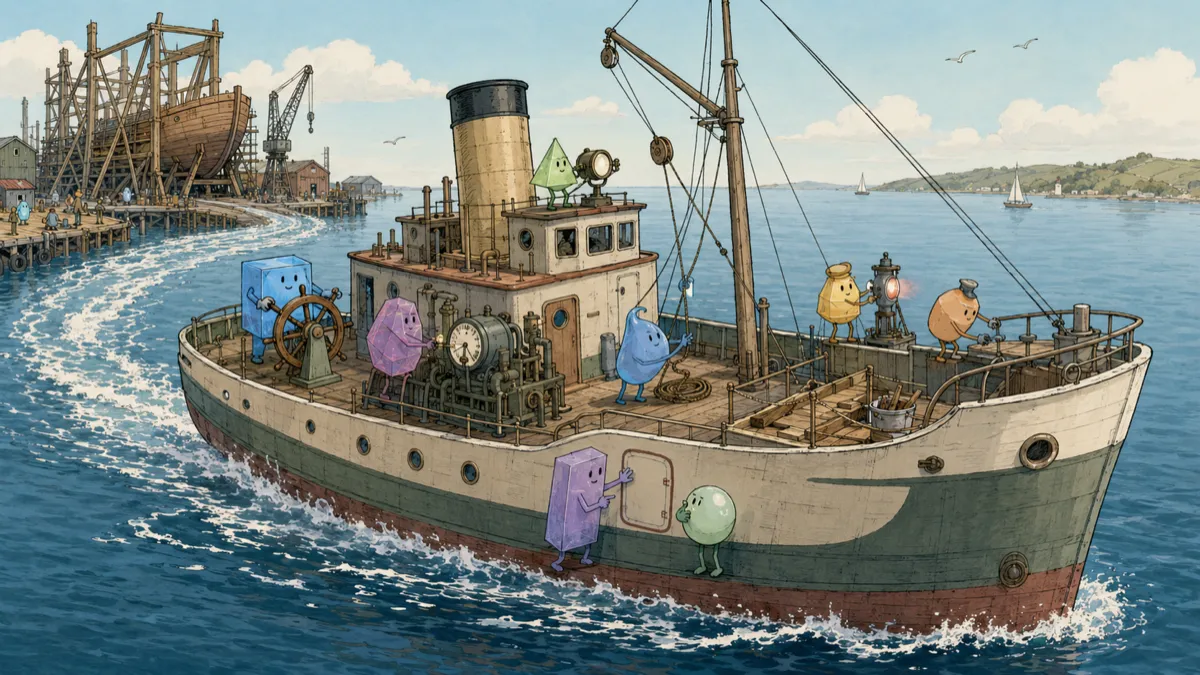
"All aboard?"
pipermorgan.ai's own domain finished moving to its new home, replacing the placeholder hosting it had been running on. A three-bug chain along the way — a redirect pointed the wrong way, a pasted address a registrar's editor couldn't parse, a certificate still catching up — each masked the next, each run down and fixed in turn.
The editorial process kept catching its own mistakes before they published. A fact-check turned up a source that had recorded what someone believed at the time, not what actually happened — a named person credited with testing a feature she'd never actually used. Caught before publish, corrected, and written down as its own category of error: a primary source can be simply wrong, not just incomplete.
📊 Governance & operations
A real capability gap now has a permanent recovery path. Infrastructure for restoring project-tracking data after a mistaken bulk edit — built after a prior, costly incident — reached a usable state: a script that compares live state against a saved snapshot and safely restores it, tested end to end before anyone had to rely on it under pressure.
Metrics (Jul 10–16):
- Issues closed: 24
- ADRs advanced: 2 (session-continuity architecture accepted, owner-scoping contract authored)
- Point releases shipped: 5 (v0.8.10.10 through v0.8.10.14)
- Alpha invites sent: 11 of 11 — first external testers live
- Beta-gate defects found pre-tester-exposure: 8, across the gate's test runs this window
- Beta Blockers sprint: grew from 2 open to roughly 21 open by window's close — the deliberate result of a structured audit that went looking for exactly this kind of thing and found it
🎯 Coming up next week
The newly-scoped audit work that grew the Beta Blockers count continues into fixes. The production hosting migration's final scope is still waiting on a call.
🚧 Blockers & asks
The shared-workspace gap needs a decision only PM can make — no fix has been attempted from inside either affected session, correctly, since guessing at the underlying cause risks making it worse.
The production-hosting migration's scope — whether a specific piece is required before beta or can follow after — has been open the whole window without a ruling.
Two smaller editorial decisions are fully staged and waiting on a spare minute: a batch data-correction to the publishing calendar, and a choice between three candidate narrative angles for an upcoming post.
🔎 This week's learning pattern
The mechanism, not the memory
Discovery: last week's pattern was making one specific wrong behavior impossible. This week, several teams independently took the next step — turning a rule someone had to remember into a contract the system refuses to let anyone break, for every future case, not just the one that prompted it.
Example from this week: the owner-scoping contract. Piper had been deciding, case by case, which data belongs to which user, building each protection by hand. That judgment is now one standing rule: any code path reading user data without properly scoping it fails automatically, and the list of what counts as "user data" derives from the codebase itself — so a future engineer can't even forget to update the list.
Why it matters: a rule that lives in someone's memory fails exactly when it's needed most — under time pressure, on someone's first day, months after whoever wrote the rule moved on. A rule the system enforces mechanically doesn't have that failure mode. It doesn't care whether anyone remembered.
Application beyond this week: anywhere a team relies on someone remembering a step — a specific check, an editing pattern, a naming convention — ask whether that memory requirement could instead be a mechanism: a tool that refuses the wrong shape, a check that runs automatically, a contract instead of a convention.
Related patterns: builds directly on last week's "impossible by construction," one level up — last week made one thing impossible to get wrong. This week made an entire class of future things impossible to get wrong, in one move each. The shared-workspace gap above is the pattern's honest counter-example: still a "please be careful" situation, not yet a mechanism — which is exactly why it's still open.
Thanks,
xian + Piper Morgan Development Team
This is Weekly Ship #052. Previous: #051 "Impossible by Construction".
P.S. Full session logs and technical details available in the GitHub repository and documentation site. Yes, you can copy it. That just makes our protocol stronger.
Week of July 10–16, 2026 | Phase: Alpha testing, beta-gate preparation