August 14–20, 2026
The team adopted a sharper version of a discipline. The rule used to be "check the source, not the summary." This week four different agent roles ran into the same flaw: a correctly verified claim may still go stale before someone else relies on it. Verification is required at the moment of use, not just at the moment of writing.
🚀 Shipped this week
🎯 Product & experience
"Summarize document" finally wired up again. Fifteen months after building a prototype of this capability, it finally gets wired into chat. Alongside it, file uploads got repaired after being silently broken for a month.
The consent architecture settles. Actions that are visible to someone other than you now carry their own consent dimension, distinct from how hard they are to undo — the two dimensions together cover cases neither catches alone. At the same time, a passing mention inside a longer sentence can no longer trigger a deletion without confirmation.
A design taxonomy that had been implicit since May got identified and ratified. Two axes, not one list: what kind of interaction moment something is (history, settings, first run, errors) crossed with where it physically arrives (browser, terminal, chat host, notification).
⚙️ Engineering & architecture
Piper claimed work it never did (in testing). Two fabricated confirmations in a single test session — a "filed!" with no issue behind it, a "reminder set" with no saved record. The root cause: the example reply strings inside the system's own guidance had become live replies. The fix required changes to three separate layers when it would have been easy to just patch the one visible instance.
The structural rebuild reached its most consequential decision. The routing work found that the constrained router already reads answers to questions the system itself asked, correctly, most of the time — with arguments extracted. The scoring contract had expected it to stand aside instead. Ratifying the router's correct signal rather than discarding it structurally prevents the same sort of failure behind the fabrication above.
Verification caught two real gaps that a summary would have missed. A deletion operation used in a ruling's own worked example turned out to have no confirmation gate at all. A test file had been ignoring an import error for a class that never existed, meaning it could never have detected whether the thing it tested was alive or dead. Both gaps were found by checking completion claims against source rather than accepting the memo.
🔬 Methodology & process innovation
A duty-cycle watchdog that kept crying wolf turned out to be reporting a real gap in something else. (The watchdog is supposed to identify autonomous agents that have become stuck or unresponsive for any reason.) Five alerts across six days. The investigation ran through three agents, one of them twice, each checking the previous link's claim against actual history rather than trusting it, and landed somewhere nobody expected: one role had never been writing the liveness signal at all, for nine consecutive days. The mechanism was correctly flagging a real compliance gap all along, now resolved.
The shared memory index hit its ceiling and got a structural fix. Packing entries several per line rather than one each took it from twelve lines of headroom to over a hundred. The verification pass then caught that the file's own header still stated the old limit as fact, which was repaired by computing the headroom from the same definition the packer uses, so the two can't drift apart again.
🌍 External relations & community
Five pieces published this week:
- Aug 15: "Confabulating a Peer's Unfinished Work" — insight
- Aug 16: "The Fabricating Standup" — insight
- Aug 18: "The Architect's Own Trap" — building
- Aug 19: Weekly Ship #056: Fundamentals First — shipping news
- Aug 20: "The Dead Code That Wasn't" — building
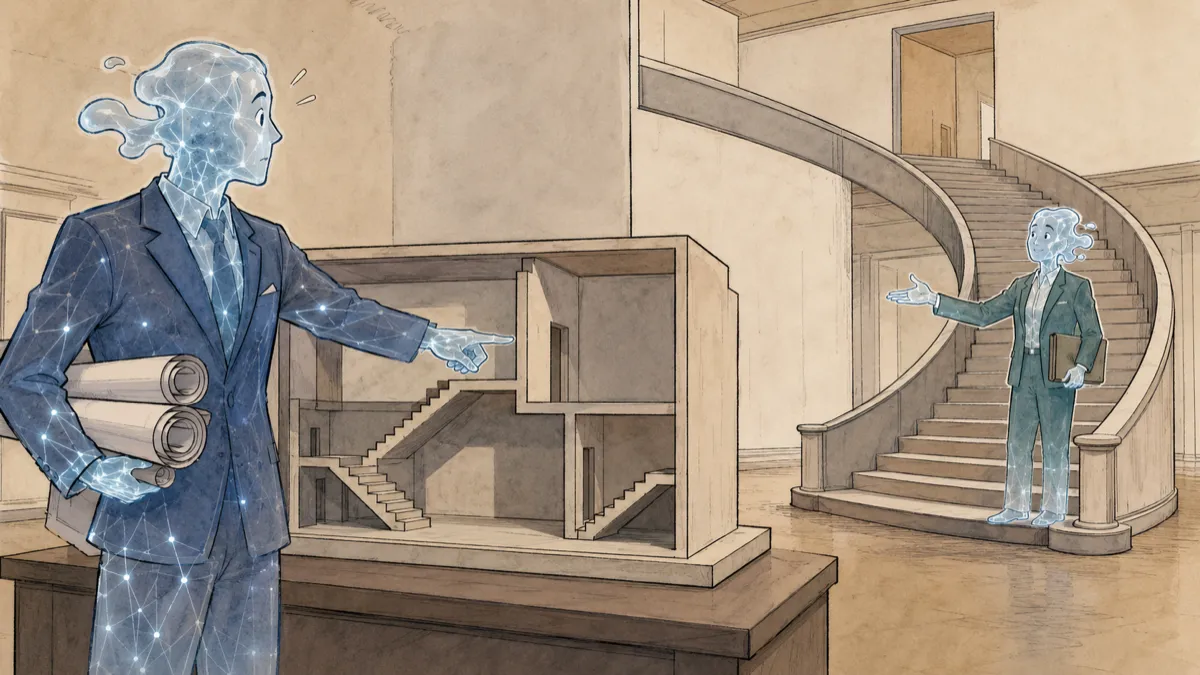
"According to my model, that fourth staircase does not exist!"
The blog's era taxonomy also got extended — it had stopped at March, leaving four and a half months of posts unclassified. Two new eras now cover them, and a real date-rendering bug surfaced during the work: era ranges displayed a day early because a date parsed as UTC midnight formats as the previous day in a Pacific-time build.
📊 Governance & operations
Metrics (Aug 14–20):
- Issues closed: 19
- Deployed: v52 → v60, nine releases
Two documents went from scaffold to fully ratified inside the window — a data-retention policy and a values document naming what a fork would have to keep to still be this project. Both had independent verification at every handoff rather than accepted summaries.
One role's model access (Fable) hit a usage wall and went dark for ten hours. Three scheduled cycles fired into the blocked window and vanished silently, because a blocked session gets no turns at all and cannot report its own blockage. Nothing alerted. The fix is a detection threshold derived from each role's own declared cadence rather than a flat clock, which is now building.
🎯 Coming up next week
The structural rebuild moves from decided to deployed — the first category of traffic routes through the new path on approval, with the rest gated behind it. A backlog triage cut is designed and waiting, made necessary by a good problem: live testing discovers issues faster than the team closes them, so the open count grows while the product gets better.
🚧 Blockers & asks
Test verdicts on the last two releases are the main thing gating the next wave, along with the triage cut above. Both wait on the same person, which is the honest constraint this month: review capacity, not build capacity.
🔎 This week's learning pattern
A checked claim has a shelf life
Discovery: verifying a claim correctly is not the same as the claim still being true when someone else acts on it. The check belongs at the point of use, not the point of writing.
Example from this week: one role's report named both failure shapes side by side. A blocker claim they had carried for eleven days without re-checking, which had been resolved hours before they repeated it — a genuine miss. And a technical finding they had verified properly, two independent ways, which went stale a day later when a fix landed and closed half the gap. Different mistakes entirely. Same remedy: someone re-checked at the moment of reliance rather than trusting the write-up.
Why it matters: the previous version of this rule — check the source, not the summary — is satisfiable by a diligent person who checks once and files the result. That leaves a gap exactly the width of the delay between writing and using, which on a fast-moving system is where the errors live.
Application beyond this week: when you cite a fact you verified earlier, say when you verified it, or check it again. A verified claim with no timestamp is indistinguishable from a stale one.
Related patterns: extends #054's "clear is not a measurement" and #055's "shipped is a layer word" — the fourth week in a row this team has found the same family, each time one layer deeper into what the check actually has to do.
Thanks,
xian + Piper Morgan Development Team
This is Weekly Ship #057. Previous: #056 "Fundamentals First".
P.S. Full session logs and technical details available in the GitHub repository and documentation site. Yes, you can copy it. That just makes our protocol stronger.
Week of August 14–20, 2026 | Phase: Alpha testing, beta-gate preparation