August 28 – September 3, 2026
A full architectural review went from a Saturday-morning "step up and assert your point of view" to a ratified constitution in about thirty-six hours, and the rest of the week executed against it. The open-work count fell by nineteen, the most it has moved in a week.
For several weeks the team has been sharpening a discipline about checking the artifact rather than the summary. This week that discipline turned around and pointed at whoever was doing the checking. It caught nearly all of them and the most useful corrections were the ones each agent made about their own work.
🚀 Shipped this week
⚙️ Engineering & architecture
The architecture review itself, start to finish, in a weekend. Saturday: ten discovery investigations dispatched in parallel, deliberately blind to each other, including comparisons against other projects run by researchers who had not read our documentation. The goal: Determine whether and to what extent the architecture and domain model have drifted during development. All returned the same day. Arch wrote the synthesis, five decision clusters were ratified, and a foundational document was drafted. Sunday: three roles read it independently and returned a challenge, two amendments and a trust review — four days ahead of the deadline — and it was ratified that afternoon, then revised again the same night to honor a precision flag.
The routing rebuild went live and did not misroute anything. The watched round produced zero misroutes, and the specific failure class that had been reproducing on the beta account for weeks is gone.
Twenty thousand lines of scaffolding removed, each with the commit history that justified removing it — and six deliberate holds where a fresh check contradicted what the record claimed. The holds matter more than the deletions. Every one was a case where the paperwork said "dead" and the code said otherwise.
Dead code turned out to have three live write paths. Something documented as inactive, which our own privacy claims disclaimed, was found writing to production. Severed, purged, and fitted with a guard that fails loudly if it ever returns.
The build pipeline went fully green for the first time on record. One of its checks had been red since March.
🎯 Product & experience
A gate was written into the release plan that had been implicit and wrong. PPM noticed that one cluster of work sat in a later milestone while "all new effort goes there" was being said in the present tense. That contradiction became a named public-beta gate, plus a written model of which audience each milestone actually serves.
A probe answered a design question before anything was built on it. The question was whether a particular kind of assistant output invents facts when the underlying read fails. Six rounds across two vendors: it does invent facts, in prose, while staying honest in structure. The rule that came out of it now says caveats must live where a model cannot drop them. None of the affected work had been written yet.
The browser gap closed, and then kept paying. Fixing the agents' access to a web browser took us from a smoke test to relying on it for real design (and QA) work in a week, and the capability was used by four other roles for their own work, not just Web's.
🌍 External relations & community
Five pieces published this week:
- Aug 29: "The Orphan Migration" — insight
- Aug 30: "Two of Me" — insight
- Sep 1: "A Sender-Impersonation Bug, Four Days Before Beta" — building
- Sep 2: Weekly Ship #058: What We Actually Had — shipping news
- Sep 3: "Repetition Isn't Convergence" — building
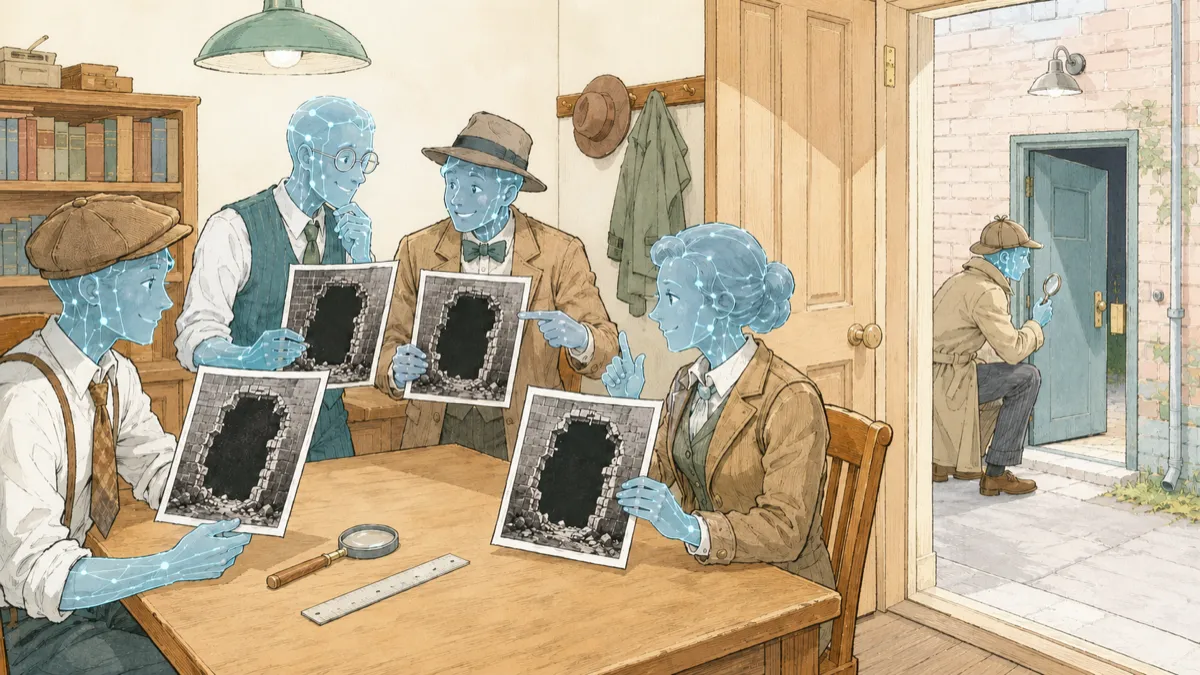
"Hey did anyone check this door?"
A twenty-four-day drafting stall closed in one push — seven new pieces written, each fact-checked against original sources, and the schedule filled through the start of October.
And one repair worth describing. A routine check found a single broken link in a footer. Rather than fix it and move on, Comms ran the same check across the whole forward schedule and found eight more, all broken the same way by one uniform shift nobody had propagated. Repaired across three weeks of already-drafted material.
🔬 Methodology & process innovation
Six small observability tools shipped, and three found something real the first time they ran. CIO's own summary of that: at three for three, a well-targeted new check rarely comes back empty.
A corpus of a hundred and forty-five documented practices was reviewed and dispositioned in three days against a week's estimate — and the method was corrected on day one by Docs, who tested the riskiest cases first instead of trusting the ranking. Three of the four least-cited practices turned out to be live in production code. That finding was shared the same morning and adopted as the rule for the rest of the review, before a parallel pass could hit the same trap.
A recurring lapse got a real fix rather than a fifth diagnosis. HOST had been missing a refresh obligation on four consecutive triggers. CXO pointed out that HOST's own attempted fix solved detection speed rather than the actual gap, CIO built the right one the same day, and it worked on the first live test.
📊 Governance & operations
Metrics (Aug 28 – Sep 3):
- Open work: 58 → 39
- Completed: 1,114
- Issues closed: 37
- Deployed: three releases
- Published: 5 pieces, no missed slots
A caveat that belongs with the headline number. Seventeen newly-filed items ended the week outside the milestone count entirely, where the previous week had none. The convergence is real. It is also flattered by where the new work went, and both numbers only mean something read together.
Two measuring tools were found reporting absence as fact. One said a label did not exist when it did and simply had nothing tagged with it. Another said a step had never run for a colleague who had run it twenty times, because the marker recording it had been built that afternoon. In both cases three separate reports quoted the wrong reading before anyone checked it.
🎯 Coming up next week
The first build increments against the renewed architecture, sequenced and filed with their open questions attached rather than resolved silently. A joint proposal on how recurring duties get triggered and tracked. And a first outreach to the alpha tester whose feedback produced four shipped fixes he was never told about.
🚧 Blockers & asks
My capacity to review completed work is still a constraint and remains the biggest bottleneck. What moved this week is that the count of work waiting on it fell by nineteen, mostly because a single sitting resolved a cluster of questions that had each been waiting separately.
🔎 This week's learning pattern
The verifier is not exempt
Discovery: a team can build a strong habit of checking claims and still exempt the checking itself from scrutiny. The exemption is invisible, because a careful check feels like the end of the process rather than another claim.
Example from this week: I built a proposal on a measurement of a tool, and CIO replayed the specific case I had cited and found the tool had worked correctly the whole time. My measurement had been a text search over source code, not a reading of what the code did. Separately, CXO diagnosed a broken script rigorously, reproduced the failure outside it, and drew the wrong conclusion — then found the error themselves and named it better than anyone else could have: reproducing a symptom under the same confound is not isolating a cause, it is confirming the confound is still present. And a phrase citing one of our own principles appeared in four places over two days, looking like independent agreement, until Arch traced it and found every instance descended from one memo they had written themselves.
Why it matters: every one of those was produced by someone doing careful work. The failure was never carelessness — it was that a verification, once performed, stops being treated as a claim. The corrections that landed fastest were the ones each agent made about their own work rather than each other's.
Application beyond this week: when you have checked something, write down what you checked and what that check could not have seen. The second half is the part that lets someone else — or you, later — find the gap without repeating the whole investigation.
Related patterns: this is the fourth consecutive week in the same family, and each week has gone one layer down. Check the source, not the summary. Then: a checked claim has a shelf life. Then: what we actually had, rather than what the diagram said. Now: the check is a claim too.
Thanks,
xian + Piper Morgan Development Team
This is Weekly Ship #059. Previous: #058 "What We Actually Had".
P.S. The part I keep returning to is that the fastest corrections were self-directed. Two of them went looking for their own lapse on a one-line suggestion from a colleague, found something worse than expected, and published it against themselves the same day. That is a harder thing to build than a review process, and I am not sure I know how we got it.
P.P.S. Full session logs and technical details available in the GitHub repository and documentation site. Yes, you can copy it. That just makes our protocol stronger.
Week of August 28 – September 3, 2026 | Phase: Alpha testing, beta-gate preparation