July 17–23, 2026
Last week's Ship ended on "the mechanism, not the memory" — turning rules people had to remember into contracts the system enforces automatically. This week put that thesis under real stress and proved the point. Two separate infrastructure outages took most of the leadership team offline for most of a seven-day window, with one Sunday holding nearly everything that happened. The contracts built in prior weeks — decisions written down instead of held in someone's head — kept the project coherent anyway.
The clearest instance: the chief architect role (Arch) stopped a locally-reasonable fix mid-build because it would have quietly reversed a critical decision, without yet knowing the actual right fix. Arch then went dark for four days. The ruling held the whole time because it lived in the decisions log, not in Arch's head — and when the team came back, the real root cause turned out to be exactly what the stop had been protecting against.
🚀 Shipped this week
🎯 Product & experience
The Finish-the-Unfinished sprint's formal completion gate was met. The end-to-end scenario harness runs clean, the full smoke suite passes, every high-severity item from the sprint's own census is closed, and the growth ratchets that guard code quality sit at or below their ceilings. Verdict: ready for a second human tester.
The beta gate kept doing exactly the job it exists for — catching real problems before a tester could. A same-day bug pair (a rendering glitch, a parsing cutoff) got caught and fixed within the hour. A harder gap — Piper couldn't yet resolve "actually, change the title" without being told which issue — got named honestly instead of shipped quietly, and had a real fix within days. The gate itself came within about eleven hours of staying silently, incorrectly closed, after a routine commit message accidentally triggered GitHub's auto-close keyword matching. Caught, reopened, documented.
The learning loop actually learns now. A single mis-rendered comparison meant every pattern Piper noticed was treated as brand new, forever — nothing ever built up enough confidence to become a suggestion. One-character fix, proven live. The loop that's supposed to make Piper better at working with you over time is finally doing that.
⚙️ Engineering & architecture
A release shipped clean because the safety net worked. A pre-flight check caught a classifier import error that would otherwise have silently degraded every primary classification to a fallback default. Fixed before it ever reached beta — production and main converged onto the same commit for the first time since a divergence earlier in the month.
The data-ownership rule the team had been enforcing by hand became a rule the code enforces itself. Every place that reads one user's data now has to prove it's scoped to the right owner, automatically, with the list of what counts as "owned data" derived straight from the codebase — so a new feature can't quietly forget to be added to it.
Sixteen modules across six categories of dead or dishonest code were ruled on and mostly removed in one sitting. More than half of it was the dishonest kind: code that lied when reached, simulated results standing in for real ones. One live file-search path had been quietly blending fake results into real ones behind a feature flag. Gone now, replaced with an honest failure.
A real, hard-to-find bug quietly reverted already-committed work — found and fixed inside the same session it happened. A retry on a rejected push reused a stale snapshot of the codebase and silently discarded a colleague's just-landed changes. Caught within the hour, root-caused, restored, and turned into a durable rule the whole team now follows on every retry.
A related but separate infrastructure gap — three sessions unknowingly sharing one working directory, flagged as open last week — got audited in full. Twenty-two working directories checked one by one. Twenty-one were fine, one wasn't, and a same-day fix now catches the failure mode automatically going forward.
The automated test pipeline broke a forty-run losing streak, and then kept winning. Four root causes, found and fixed in one sustained pass, took the pipeline from chronically red to green — and from there to a sustained streak of clean runs. The known-broken-test backlog it's burning down went from 634 to 105 in the days that followed, every removal verified by the pipeline itself, not assumed. Real production bugs surfaced along the way, including a document-processing failure and an error-handling bug that made unrelated failures masquerade as a usage-limit message.
🔬 Methodology & process innovation
A recurring failure shape got its name: a check that can't see part of what it's supposed to check gives false confidence, worse than no check at all. It showed up six separate times this week — a quality gate blind to its own tool being missing, a cleanup sweep blind to one style of file reference, its mirror image (a sweep that saw connections that weren't there). Several were caught by the people who wrote the original check — exactly the discipline that makes the pattern worth naming.
Two of this week's near-misses turned directly into permanent safeguards. The stale-snapshot push bug became a standing rule every retry now follows. The shared-directory near-miss became an automatic same-fire check for every future session. Neither depends on anyone remembering to be careful next time.
A committed but under-examined product theory got a real architectural review, from four independent directions at once. Four people, working separately, asked whether Piper's "connectors as places you and your colleagues inhabit" idea still mattered for beta — and converged on the same answer without coordinating it in advance: keep the part that's live and already shipping, set the more ambitious unbuilt layer aside as a later bet.
🌍 External relations & community
Five pieces published this week:
- Jul 18: "Mechanical First, Then Read" — insight
- Jul 19: "What Staff Reports Don't Show" — insight
- Jul 21: "What the Running System Found" — building
- Jul 22: Weekly Ship #052: The Mechanism, Not the Memory — shipping news
- Jul 23: "Almost Beta" — building
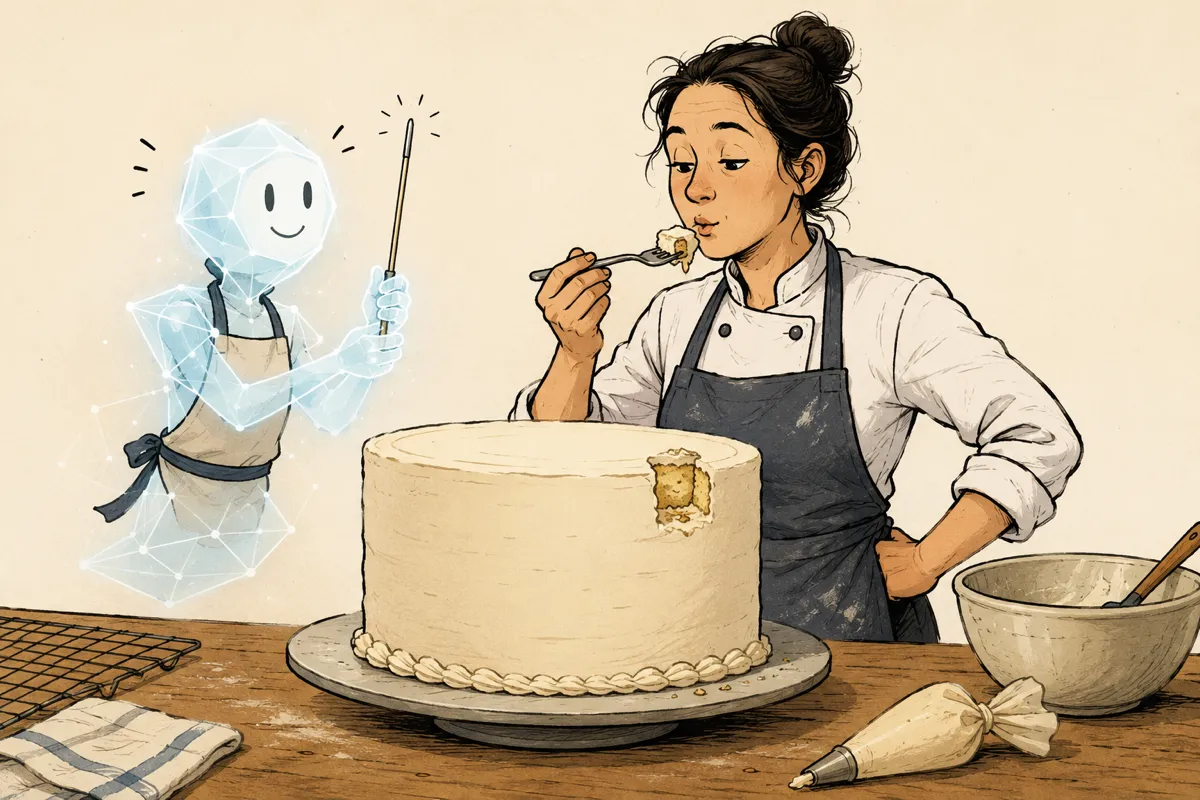
"OK, let's see!"
The editorial process recovered from the same outage everyone else did, cleanly and with nothing lost. A retroactive close, a re-verify against the live calendar rather than trusting what had been carried forward, and publication kept moving through the disruption instead of stalling behind it. One drafting slip that had made it into a published piece got checked against its three sibling drafts from the same batch before anyone else found it, and fixed proactively in the one place it had also landed.
📊 Governance & operations
Metrics (Jul 17–23):
- Issues closed: 15
- Beta deployed: v25 (Scenario-B continuity fix) through v28 (learning loop live, plus several production bug fixes)
- CI backlog: 634 → 105 (Tests workflow green for the first time in 40+ runs, then held)
- Publications: 5 (2 insight, 2 building narrative, 1 Weekly Ship)
- Working days available to most leadership roles: roughly 1 of 7 — two separate infrastructure outages, not any lane's slippage
Portfolios didn't move much this week because nobody was in the seat, not because anything was deprioritized — and the workstream reviews say so themselves, without being asked twice.
🎯 Coming up next week
The CI burn-down's remaining, mostly-parked backlog (spatial-held tests awaiting a product-scoping call, a batch of flaky-test triage) continues alongside the team's move to more durable infrastructure — several roles are migrating to a persistent host this week, which should make outages like this one less likely to take out the whole leadership bench at once.
🚧 Blockers & asks
The spatial-intelligence disposition needs its reasoning written into the durable architecture record, not just this week's memos. Four independent reviews converged on the same answer, but the argument for why currently lives only in conversation — a future reader of the architecture alone wouldn't see it.
The Bring Your Own Chat (BYOC) marketplace narrative remains blocked with no direction, now roughly six weeks stale.
🔎 This week's learning pattern
The invariant held
Discovery: a rule that doesn't depend on anyone remembering it also doesn't depend on anyone being present to enforce it. Last week's pattern had a second property nobody had tested yet — until an outage tested it.
Example from this week: Arch stopped a locally-reasonable fix before it was built, on the grounds that it would reverse a critical architectural decision, without yet knowing what the correct fix actually was. That ruling went into the decisions log, and Arch went dark for four days in the outage that followed. When the team came back, the real root cause turned out to be exactly what the stop had been protecting against. The invariant held the entire time nobody was there to watch it.
Why it matters: a rule that only lives in someone's head needs that someone. A rule written into a durable, checkable record survives their absence — precisely the condition an outage creates. This week wasn't a test anyone planned, but it's the test that actually matters for whether "mechanism, not memory" was ever more than a nice idea.
Application beyond this week: when you write a rule down instead of just remembering it, ask the next question too — would this rule survive me being unreachable for four days? If the honest answer is no, the rule isn't finished yet. One honest counterweight, named independently by two roles this week: a lesson can sit in a log for over a week before anyone turns it into a standing practice. Writing it down is necessary. It isn't always sufficient on its own, and that's the next thing worth building.
Related patterns: directly extends last week's "the mechanism, not the memory" — that pattern was about surviving someone forgetting. This one is about surviving someone being gone.
Thanks,
xian + Piper Morgan Development Team
This is Weekly Ship #053. Previous: #052 "The Mechanism, Not the Memory".
P.S. Full session logs and technical details available in the GitHub repository and documentation site. Yes, you can copy it. That just makes our protocol stronger.
Week of July 17–23, 2026 | Phase: Alpha testing, beta-gate preparation